FLDG under RBI rules: what a default loss guarantee asks of the lender after disbursal
FLDG, which RBI calls default loss guarantee (DLG), rule by rule: the 5% cap, the three permitted forms, the 120-day invocation limit, disclosure, and the record a lender keeps for each covered portfolio.
Contents 13 sections
If your NBFC lends through a fintech partner that covers your first losses, you sign the guarantee once and administer it for the life of the portfolio. The 5% ceiling is agreed at signing. The 120-day invocation limit, the frozen list of covered loans and the rule that invoked cover never comes back all play out in servicing, loan by loan, for as long as the portfolio is live.
So FLDG belongs on your own loan record, not in a spreadsheet your partnerships team rebuilds from the partner’s monthly report. That record is where Lokta, the agentic loan servicing platform, comes in.
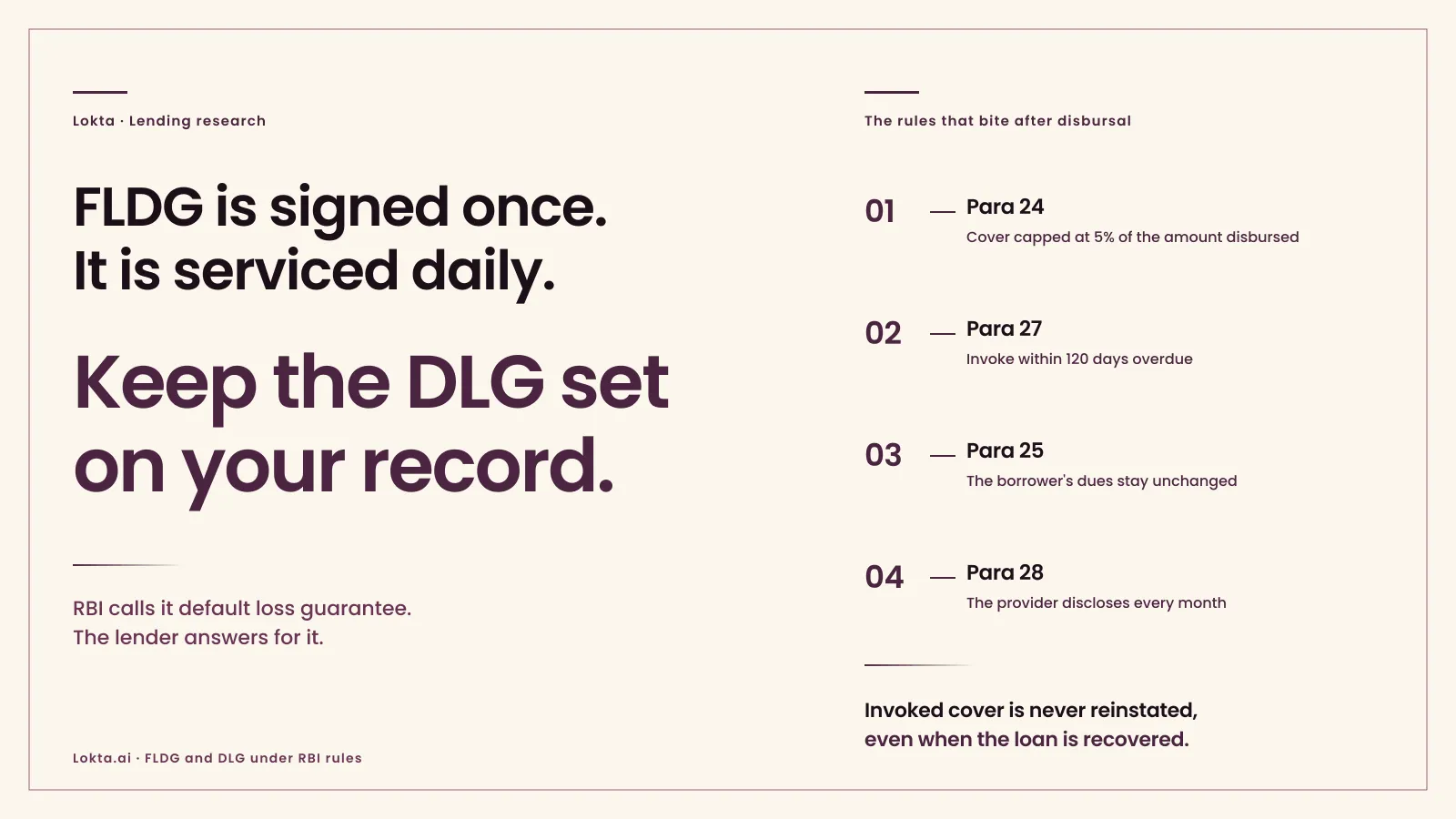
FLDG, or first loss default guarantee, is a promise by a lending partner to cover a lender’s losses on a defined set of loans. RBI calls it a default loss guarantee (DLG). For NBFCs the rules sit in paragraphs 19 to 29 of Chapter III of the NBFC Credit Facilities Directions, 2025. The cover is capped at 5% of the amount disbursed from the covered set, must be cash, a lien-marked fixed deposit or a bank guarantee, and must be invoked within 120 days overdue.
What changed, and from when?
RBI’s DLG rules have moved twice since RBI first permitted the arrangement, and the core rules carried over each time. If you’re an NBFC, the paragraph numbers you cite today are 19 to 29 of the NBFC Credit Facilities Directions, 2025, in the version updated as on 15 July 2026.
| Date | Instrument | What it did to FLDG |
|---|---|---|
| 10 Aug 2022 | RBI press release implementing the digital lending working group’s recommendations | Kept the recommendation on FLDG under examination |
| 8 June 2023 | Guidelines on Default Loss Guarantee (DLG) in Digital Lending | Permitted DLG, “commonly known as FLDG”, with the 5% cap, the three forms and the 120-day limit |
| 8 May 2025 | Digital Lending Directions, 2025 | Folded the 2023 circular into Chapter VI and repealed it |
| 28 Nov 2025 | Credit Facilities Directions, 2025, issued separately for NBFCs, commercial banks and other lender types | Moved the DLG rules into Chapter III, paragraphs 19 to 29, of the NBFC and commercial bank directions |
Banks use the same numbering. The Commercial Banks Credit Facilities Directions, 2025, updated as on 1 October 2026, carry DLG in paragraphs 19 to 29 of their own Chapter III, with one restriction the NBFC text doesn’t carry: paragraph 21(1) bars a bank from DLG on revolving credit facilities offered through a digital lending channel and on credit cards. We quote the NBFC text here. If your partner agreement or credit policy still cites the 2023 circular, the rules carry over, but the references don’t.
What counts as FLDG in RBI’s text?
Any upfront promise by another entity to compensate you for default losses on your portfolio, up to a set percentage. Paragraph 4(1)(viii) defines a DLG as such a contract “called by whatever name”, and it also covers any implicit guarantee of a similar nature that is linked to the portfolio’s performance and specified upfront. Read that way, an arrangement that pays you back as defaults rise can fall inside it even when the agreement doesn’t use the word guarantee.
Paragraph 29 carves out guarantees you may already hold under CGTMSE, CRGFTLIH and NCGTC schemes, and credit guarantees from the BIS, the IMF and multilateral development banks.
For your servicing team, that means keeping a list of every partner arrangement that pays out on defaults, whatever it’s called. Each one carries the obligations that follow.
Who can give a default loss guarantee?
Only a lending service provider, or another lender engaged as one, incorporated as a company under the Companies Act, 2013 (paragraph 19). RBI’s definition of an LSP names servicing, monitoring and recovery among the functions it can carry out for you, so the partner that guarantees your losses can also be the one collecting on your loans.
Paragraph 20 gives you three duties before the arrangement starts:
- a policy on provider eligibility, the nature and extent of cover, how the arrangement is monitored and reviewed, and any fees
- a rule that DLG never substitutes for credit appraisal, with underwriting standards held whatever the cover
- at every entry and renewal, a declaration from the provider, certified by its statutory auditor, of its total DLG outstanding, the number of lenders and portfolios it covers, and past default rates on similar portfolios
Paragraph 21 bars DLG on loans already covered by the credit guarantee trust fund schemes, and it bars NBFC-P2P platforms from DLG altogether. If you’re a P2P platform, this guide isn’t for you.
In servicing terms, you’ll need a fresh auditor-certified declaration at every renewal. If your partner record shows the arrangement’s start and renewal dates, you can show which declaration covered which period.
Which forms can the cover take?
Three, and you can’t accept anything else (paragraph 23):
- cash deposited with the lender
- a fixed deposit with a scheduled commercial bank, with a lien marked in the lender’s favour
- a bank guarantee in the lender’s favour
Paragraph 22 requires your contract to state the extent of cover, the form it’s held in, the timeline for invocation and the disclosure the provider will make. Paragraph 27(2) adds a term rule: the agreement must stay in force for at least the longest tenor of any loan in the covered portfolio.
Your record should hold the form and the instrument details for each portfolio. RBI’s tenor rule applies to the agreement, not the instrument. So if a fixed deposit or bank guarantee has its own end date, check it. One that ends before the last loan in the set matures is a risk you’ll want to see coming.
How does the 5% cap work?
Your cover on a portfolio can’t exceed 5% of the total amount disbursed out of it at any given time (paragraph 24(1)). For an implicit arrangement, the provider can’t bear performance risk above the equivalent of 5% of the portfolio. The covered portfolio, which RBI calls the DLG set, is a fixed list of sanctioned loans. Paragraph 24(2) says it isn’t meant to be dynamic, and RBI’s illustration says loans leave it only through repayment or write-off.
Here’s RBI’s own worked example from paragraph 24(3), with dates in 2024 and amounts in ₹ crore:
| Step | What happened | Outstanding | Cover available |
|---|---|---|---|
| Earmark | A ₹40 crore set is frozen. The ceiling is fixed at ₹2 crore | 0 | 0 |
| 1 April | ₹10 crore disbursed | 10 | 0.5 |
| 15 April | A further ₹10 crore disbursed | 20 | 1 |
| 30 June | ₹5 crore matures without default | 15 | 1 |
| July to September | ₹2 crore defaults. The lender invokes the full ₹1 crore | 15 | 0 |
| October | ₹1 crore recovered on the defaulted loans | 14 | 0 |
Cover activates as loans are disbursed, so a set that’s sanctioned but only partly disbursed has only part of its ceiling. And the October recovery lowers the outstanding portfolio but adds nothing back to the cover.
On RBI’s illustration, cover available works out as 5% of the amount disbursed from the set, less everything invoked. That figure moves with each disbursal and each invocation, so you need a running balance for it on each DLG set. You can hold more than one DLG set. RBI’s illustration says so.
When must the lender invoke it?
Within a maximum overdue period of 120 days, unless the borrower makes the dues good before that (paragraph 27(1)). Your contract can set an earlier trigger, and paragraph 22 requires it to state the timeline for invocation.
The 120 days run on days past due, and that’s a loan-level count. Your system has to know which loans sit in which set, compute each one’s DPD from what’s actually unpaid, and raise the invocation before the earlier of the contractual trigger and day 120. If a misposted receipt throws a DPD figure off, you can miss the limit, or invoke cover on a loan that was current.
What happens to the borrower’s loan after invocation?
Nothing changes on the borrower’s side. Paragraph 25 sets four rules:
- asset classification and provisioning follow the NBFC income recognition and asset classification directions, guarantee or not (25(1))
- the invoked amount is not set off against the underlying loans, so the borrower’s liability stays the same (25(2))
- recoveries on loans where DLG was invoked can be shared with the provider as the contract says (25(3))
- an invoked amount is never reinstated, recovery included (25(4))
Paragraph 26 keeps capital computation on the individual loans under the capital adequacy directions. If you’re an NBFC giving DLG to another lender, you deduct the full outstanding amount from your own capital.
After you invoke, two balances exist for the same loan. The borrower’s account still shows the full overdue amount, and collections continue on it. Where the cover is cash, you hold it against the DLG set. A fixed deposit or bank guarantee sits as an instrument, not a balance. When the borrower later pays, you need both records to work out what, if anything, goes back to the provider under the contract. How the receipts and the cover are booked under Ind AS is your auditor’s call. On the borrower’s side, RBI’s text fixes only that the guarantee never reduces what the borrower owes.
What has to be disclosed, and by whom?
The provider publishes it, and you have to make sure it happens. Paragraph 28 requires you to have a mechanism so that each LSP giving you DLG publishes, on the LSP’s website, the total number of portfolios under DLG and the amount of each. The disclosure is monthly, no later than 7 working days after the month ends. The LSP may or may not name the lenders.
The partner’s published figures and yours for the same portfolios should agree each month. When they don’t, the cause can be, for example, a set the two sides define differently or a disbursal one side hasn’t recorded.
How is FLDG different from co-lending?
In co-lending, both lenders fund each loan and hold a share of it in their books. In a digital lending DLG, the provider funds nothing and holds no part of the loan, and paragraph 30(2) says a conforming DLG is neither synthetic securitisation nor loan participation. It promises cash against defaults on loans that sit wholly on your books.
- The provider is an LSP, or a lender engaged as one, and funds none of the loan.
- The loan sits wholly on the lender’s books.
- The cap is 5% of the amount disbursed from the DLG set.
- The rule sits in the Credit Facilities Directions, paragraphs 19-29.
- The partner is another regulated lender that funds its share of each loan.
- The loan is split between two books, and an NBFC keeps at least 10% of each one.
- The cap on a guarantee from the originating lender is 5% of loans outstanding under the arrangement.
- The rule sits in the Transfer and Distribution of Credit Risk Directions, paragraphs 102 and 123.
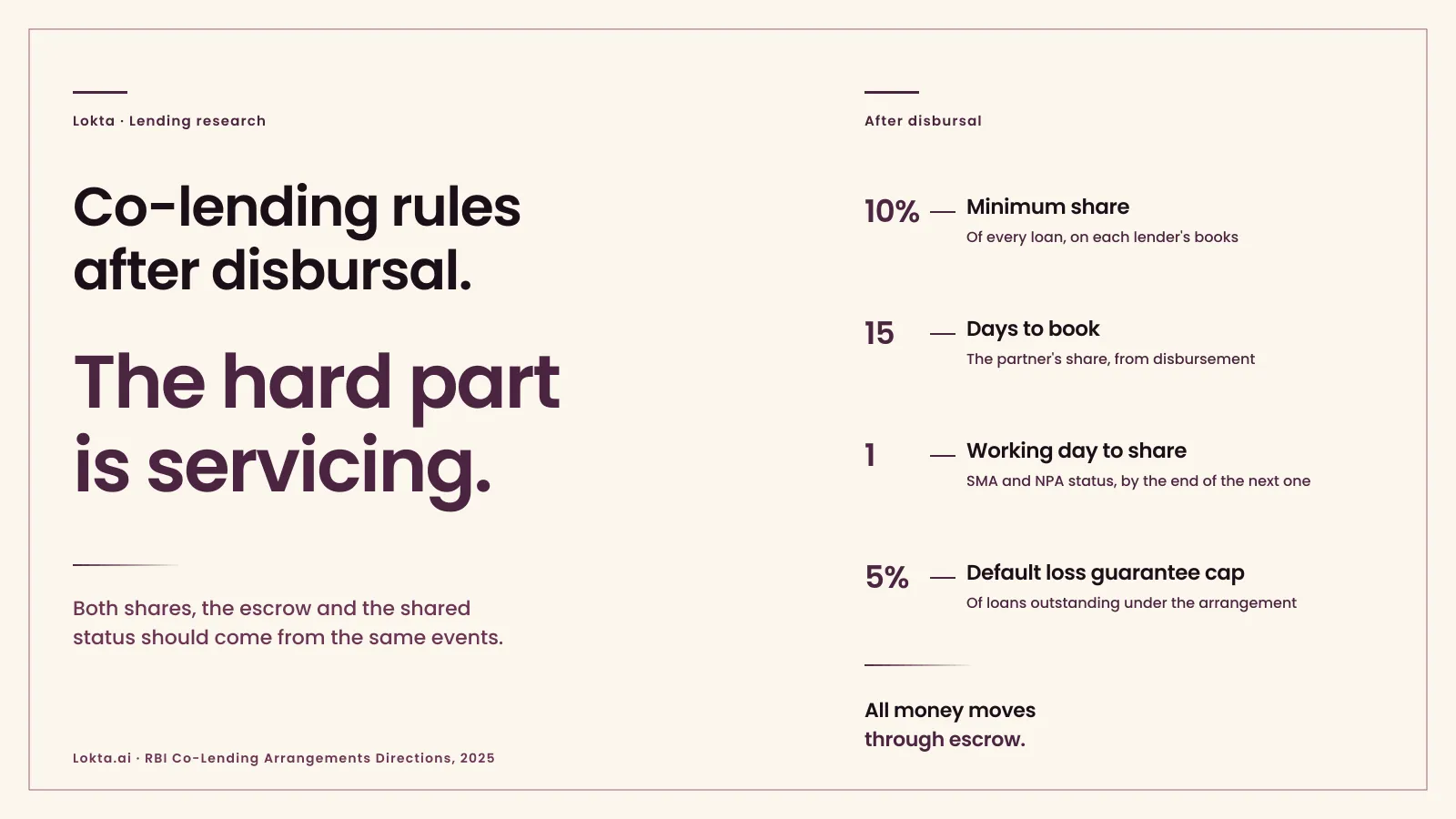
The two meet in paragraph 123 of the NBFC Transfer and Distribution of Credit Risk Directions, 2025: an originating NBFC may give its co-lender a default loss guarantee of up to 5% of loans outstanding under the arrangement, governed by the Credit Facilities rules with the necessary changes. Paragraph 111 bars fees for lending services from carrying any element of credit enhancement or DLG unless the rules permit it. The co-lending directions guide covers the escrow and classification rules that come with a shared loan.
What does the lender’s record need for each DLG set?
Enough for you to answer for the guarantee without asking the partner. Paragraph 6(7) keeps you “fully responsible and liable for all acts and omissions of the LSP”, and under paragraph 19 the provider of the guarantee is always an LSP. So the record sits with you:
- the set itself: the fixed list of covered loans, the earmark date, the provider and the agreement version
- the form of cover, the instrument reference and any end date, checked against the longest loan tenor
- cover available, recomputed on each disbursal and each invocation, never raised by a recovery
- each covered loan’s DPD against the contractual trigger and the 120-day limit
- each invocation: the loans, the amount, the date, who approved it
- recoveries after invocation and the share owed back under the contract
- the provider’s monthly website disclosure, compared with your own figures
- the auditor-certified declaration for each entry and renewal
One path is a spreadsheet built from the partner’s monthly report. It needs no integration, but the DPD it relies on is the partner’s, and you can’t show your own count when an invocation is questioned. The opposite path leaves everything with the partner under the contract. That gives up your own evidence entirely, and the liability doesn’t move. The middle path keeps the set, the DPD and the invocations on your record, with the partner’s reports reconciled against it each month. It costs you mapping work for each partner, and someone on your team has to own that mapping as partners change their systems. That’s the trade-off, and it’s the one we’d make.
Lokta’s loan management system works out DPD on each loan from what’s still due, matches bank statements and collection files to the ledger with unmatched money held in suspense on an ageing view, and posts every financial event double-entry to your mapped GL heads. Each loan keeps its sourcing partner and the arrangement version it was booked under, and partner payouts go through maker-checker approval, as the multi-lender servicing page describes. A dedicated DLG-set balance is the part you should test in any demo, ours included. The digital lending software page sets out what Lokta holds after your own app approves a loan. Lokta is built by the team behind Apache Fineract, the open-source lending core.
The FLDG calendar
| When | What the lender does | Paragraph |
|---|---|---|
| Before signing and at each renewal | Check the provider is eligible, apply the DLG policy, obtain the auditor-certified declaration | 19, 20 |
| At signing | Fix the DLG set, the form of cover, the invocation trigger and the disclosure terms | 22, 23, 24(2) |
| On each disbursal from the set | Raise cover available in proportion to the amount disbursed, up to the 5% ceiling, less anything invoked | 24(1) |
| Every day | Recompute DPD on each covered loan against the trigger and the 120-day limit | 27(1) |
| On invocation | Draw the cover, leave the borrower’s dues unchanged, keep classification on the normal rules | 25 |
| By the 7th working day of each month | Check the provider’s website disclosure against your own figures | 28 |
| On recovery after invocation | Share under the contract, and leave the cover where it is | 25(3), 25(4) |
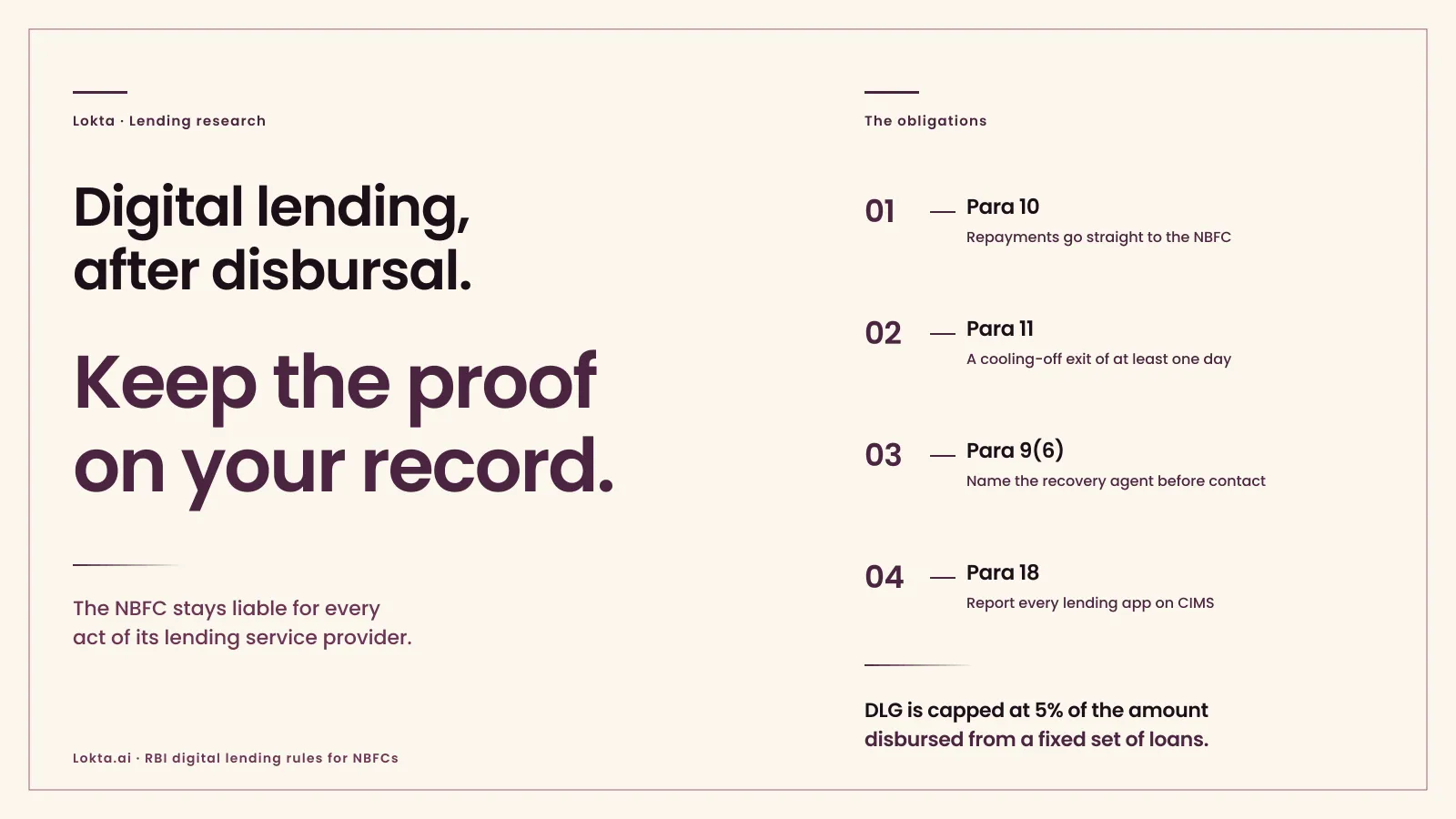
The RBI digital lending rules guide covers the rest of Chapter III, from direct repayment to DLA reporting on CIMS.
Frequently asked questions
What does FLDG mean in lending?
FLDG stands for first loss default guarantee. A lending partner, such as a fintech acting as the lender's lending service provider, promises to cover a lender's losses on a defined set of loans up to an amount fixed upfront. RBI's rules call the arrangement a default loss guarantee, or DLG, and treat any implicit promise of the same kind as a DLG too. For an NBFC, the rules sit in paragraphs 19 to 29 of Chapter III of the NBFC Credit Facilities Directions, 2025, and cap the cover at 5% of the amount disbursed from the covered portfolio.
Is FLDG allowed by RBI?
Yes, within limits. RBI permitted default loss guarantee arrangements on 8 June 2023, after holding the question under examination since August 2022. The current rules for NBFCs are in the Credit Facilities Directions, 2025: the provider must be a lending service provider, or another lender engaged as one, incorporated as a company. The cover can be cash, a lien-marked fixed deposit with a scheduled commercial bank, or a bank guarantee, and it can't exceed 5% of the amount disbursed from the covered portfolio.
When must a lender invoke a default loss guarantee?
Within a maximum overdue period of 120 days, unless the borrower clears the dues first, under paragraph 27(1) of the NBFC Credit Facilities Directions, 2025. Invocation doesn't reduce what the borrower owes, and recoveries after invocation can be shared with the provider as the contract sets out. Once invoked, an amount never returns to the available cover, even when the lender later recovers the loan. In practice, your system has to track each covered loan's days past due against that limit.
What is the difference between FLDG and co-lending?
In co-lending, two regulated lenders each hold a share of every loan, and an NBFC co-lender keeps at least 10% of each one in its books. In a digital lending DLG, the provider holds no part of the loan. It only promises to absorb defaults on a fixed set of the lender's loans, up to 5% of the amount disbursed from them. A co-lending arrangement can carry its own guarantee from the originating lender, capped at 5% of the loans outstanding under the arrangement.
Read next
- RBI digital lending rules for NBFCs: what you have to evidence after disbursal: every post-disbursal obligation in Chapter III, with paragraph numbers.
- RBI Co-Lending Directions 2025: what changes after disbursal: the 10% share, escrow and shared SMA and NPA status.
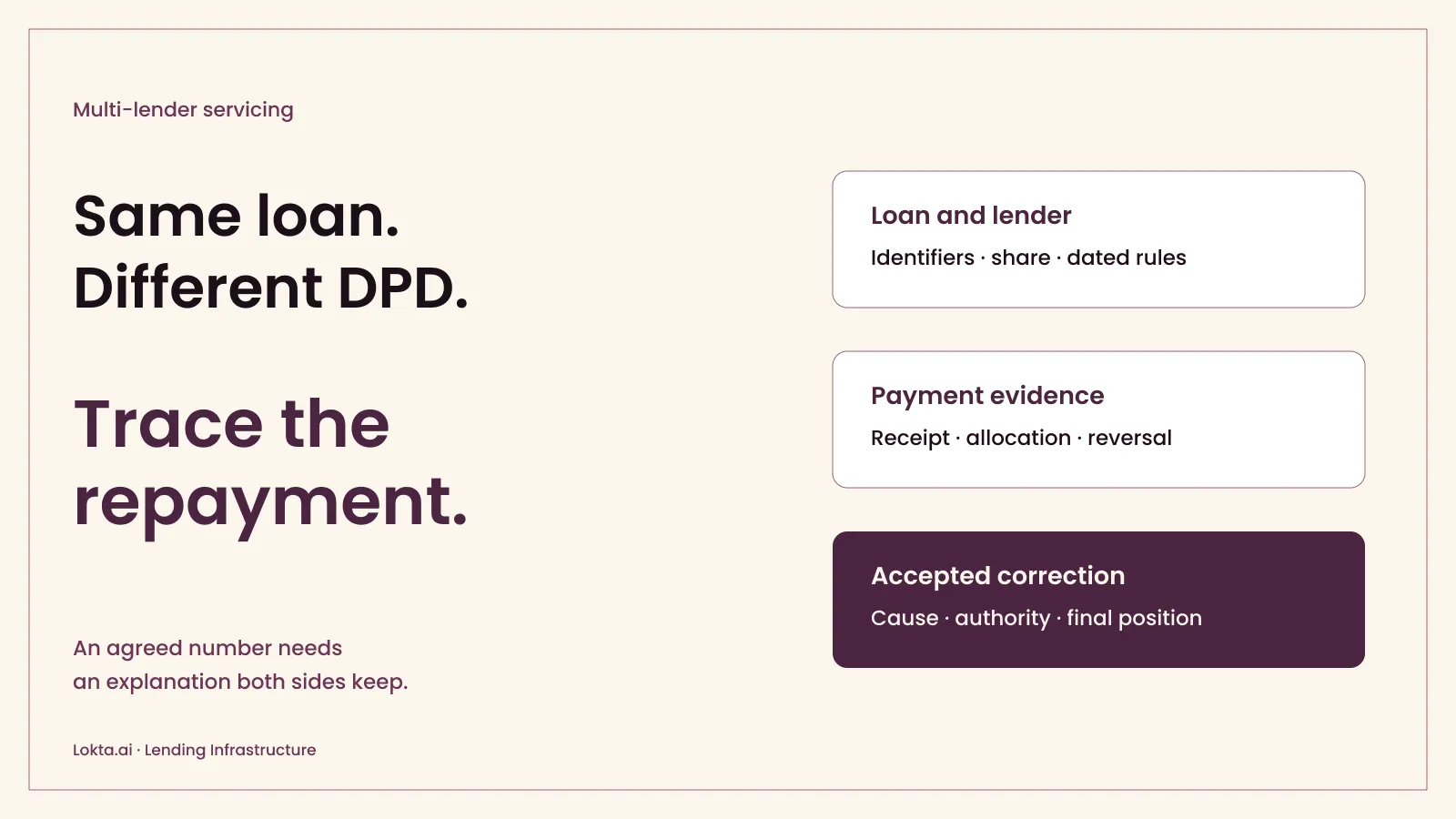
- Multi-lender repayment and DPD reconciliation: how to keep guarantee money apart from borrower repayments when two records disagree.
Sources:
- RBI, Reserve Bank of India (Non-Banking Financial Companies - Credit Facilities) Directions, 2025, updated as on 15 July 2026: paragraph 4(1)(viii) and (xix) (definitions), paragraph 6(7) (liability for the LSP), Chapter III section E, paragraphs 19-29 (DLG), paragraph 30(2), paragraph 112 (repeal).
- RBI, Reserve Bank of India (Commercial Banks - Credit Facilities) Directions, 2025, updated as on 1 October 2026: Chapter III, paragraphs 19-29.
- RBI, Reserve Bank of India (Non-Banking Financial Companies - Transfer and Distribution of Credit Risk) Directions, 2025, updated as on 1 July 2026: paragraphs 102, 111 and 123 (co-lending).
- RBI, Reserve Bank of India (Digital Lending) Directions, 2025, RBI/2025-26/36, 8 May 2025: Chapter VI and Annex III.
- RBI, Guidelines on Default Loss Guarantee (DLG) in Digital Lending, RBI/2023-24/41, 8 June 2023, now repealed.
Lokta editorial analysis by Chandramouli, co-founder and CEO.