Loan-level accounting: three ways to keep a loan book, and the one an auditor can test
Loan-level accounting means every ledger balance splits into loans, and every loan balance splits into dated events. Compare three ways lenders keep the book.
Contents 9 sections
Every balance in a lender’s books is yours to explain once you’ve signed them. Loan-level accounting is what lets you explain it by loan and by date. A book that stores one balance per loan does only half of it.
A loan system that stores each loan’s balance, but can’t recompute it from dated events, gives you loan-level balances. It doesn’t give you loan-level accounting. The difference only shows up when someone asks about a past date: an auditor, an RBI inspection team, or a co-lending partner disputing a number.
Lenders keep a loan book in one of three ways. We compare them on the 4 questions finance, risk and audit actually ask.
| The question asked | 1. Portfolio totals in the GL | 2. Balance per loan, updated in place | 3. Balance per loan, from dated events |
|---|---|---|---|
| Which loans make up this GL balance? | A report or export, rebuilt outside the books | Yes, for today | Yes, for any date |
| What was this loan’s balance on 30 June, as known then? | Not from the ledger | Only if a snapshot was kept | Yes, from the events up to that date |
| Why did the balance change? | A journal line with a narration | The latest value, and an edit log if one exists | The event, its date and the rule that applied |
| Is the stored balance right? | Compared with a second copy | Compared with a second copy | Recomputed and compared |
Loan-level accounting means every general ledger balance splits into the individual loans behind it, and every loan balance splits into the dated events that produced it. RBI’s borrower-wise NPA classification, Ind AS 109’s effective interest method and co-lending’s account per lender share all start from the individual loan. A loan system that only stores today’s balance per loan meets part of that. A system that derives each balance from dated events and the rules in force meets all of it, and can show its working.
What loan-level accounting means
Loan-level accounting describes how the record is kept. Your general ledger holds the books. On a lender’s ledger, the loan control accounts (principal, interest receivable, charges, interest suspense, provisions) each hold a total. Loan-level accounting means you can split each of those totals into the loans behind it, and split each loan’s figure into dated events.
You need two splits:
- Ledger to loan. Every posting to a loan control account carries the loan it belongs to. Say your interest receivable head shows ₹2 crore on 30 September. You can list the loans that make it up, and the list adds to ₹2 crore.
- Loan to event. Every loan figure is the sum of dated events: disbursal, accrual, repayment, charge, waiver, reversal, write-off. Each event records when it happened, when it was posted, and which rule computed it.
The second split is the one to test for. It’s also the one a deterministic core gives you: the same events and the same dated rules always produce the same balance, so you can recompute a balance instead of trusting it. We cover the journal entry for each event in loan accounting entries for lenders. This guide is about how fine your record has to be.
What RBI and Ind AS already ask for, loan by loan
RBI and Ind AS don’t use the phrase “loan-level accounting”. Their rules assume the detail anyway. The IRACP Directions of 28 November 2025, the 2025 co-lending rules and Ind AS 109 each ask for it, and the Companies (Accounts) Rules, 2014 add an edit log.
- Borrower-wise classification. Paragraph 23 of RBI’s IRACP Directions, 2025 says asset classification “shall be borrower-wise and not facility-wise” (paragraph 20 carves out an NBFC-MFI’s microfinance portfolio). If a borrower’s business loan turns NPA, their vehicle loan with you does too. You can’t apply that rule to a product total.
- Day-end flags. Paragraphs 18 and 19 require overdue, SMA and NPA flags to be set in the day-end process for the relevant date, whatever time that process runs. An EMI due on 5 July and unpaid is overdue in the 5 July day-end run. Each flag belongs to an account and a date.
- Income on NPAs. Paragraph 38 says income on an NPA is recognised only when it’s realised, and income recognised earlier but not realised is reversed. Say ₹40,000 of interest was accrued and unpaid when a loan turned NPA. You reverse that ₹40,000, along with unrealised income on any other facility the borrower holds with you, and you book later interest only when it’s paid. That’s the prudential rule. If you report under Ind AS, paragraph 8 lets the standard prevail where the two differ, so your books keep recognising interest on the impaired loan’s amortised cost.
- Two calculations for Ind AS NBFCs. If you’re an Ind AS NBFC, paragraph 34 asks you to hold impairment allowances under Ind AS and, in parallel, to keep RBI’s borrower-wise classification and provisioning as the prudential floor. If your Ind AS impairment is lower, paragraph 35 puts the difference in an Impairment Reserve.
- Interest per asset. Under Ind AS 109 paragraph 5.4.1, interest revenue is the effective interest rate applied to the gross carrying amount of a financial asset, and to its amortised cost in reporting periods after that asset becomes credit-impaired. Paragraph 5.5.4 contemplates assessing significant increases in credit risk on an individual or collective basis. That flexibility sits in the impairment section. Paragraph 5.4.1 has no collective option, and the switch to amortised cost is decided asset by asset.
- Co-lending shares. For NBFCs, Part B of RBI’s Transfer and Distribution of Credit Risk Directions, 2025 requires each lender to keep at least 10% of each individual loan (paragraph 102) and to maintain the borrower’s account individually for its share (paragraph 116). On an 80:20 loan, that’s two accounts for one borrower, and every EMI splits between them.
- The edit log. For financial years from 1 April 2023, the proviso to Rule 3(1) of the Companies (Accounts) Rules, 2014 requires a company to keep its books in software that records an audit trail of every transaction and an edit log of each change, with the date of the change. If your loan system posts entries that form part of the books, expect your auditor to ask for its log too.
All but the last start from an account and a date. So the way you keep the book decides whether you meet them inside the ledger or in a spreadsheet beside it.
Option 1: portfolio totals in the general ledger
Your loan system, or a spreadsheet, produces product-level totals at month end, and finance posts them as journals. Loan detail lives in reports.
Choose this when your book is small, you run one product with one lender, and your auditor accepts a report as the bridge between ledger and loans. You don’t need any mapping work, and it suits a general ledger finance already runs in Tally or a similar package.
What it costs you. You apply every rule in the list above outside the books, then summarise the result into them. When a backdated receipt or a mid-month NPA changes a total, the explanation sits in a file, not the ledger. Your subledger to general ledger reconciliation becomes the place where those differences pile up every close.
Option 2: a balance per loan, updated in place
When you evaluate a loan management system, check whether it works this way. Each loan has a current balance, a status and accrued interest. Events update those fields, and the system posts summarised journals to your general ledger.
Choose this when your questions are about today: which loans make up a balance now, who’s overdue now, what to collect this week. The ledger-to-loan split works, and that’ll cover a lot of your servicing.
What it costs you. The loan-to-event split is weak. Say a ₹15,000 receipt dated 14 August gets posted on 19 August. The system changes today’s balance. If the EMI was due on 14 August, the loan showed as overdue for 5 days when it wasn’t. Whether it also recomputes the days past due, the SMA date and the interest that depended on the old balance is up to the system. If it doesn’t, the stored figure is wrong, and it still agrees with every copy made from it. We call that ledger drift: a book that reconciles and is still wrong, because both sides copied the same number.
A daily snapshot shows you what the balance was. It won’t tell you what it should have been.
Option 3: a balance per loan, derived from dated events
Here each loan’s balance, status and accrual is computed from its dated events and the rules in force on each date. The system keeps the events, so you can recompute any loan for any date, and each posting to your general ledger carries the loan and the event that caused it.
Choose this when you co-lend, run more than one product, report under Ind AS, or your auditor has asked you to explain a balance as at a past date. The ₹15,000 receipt posts with its 14 August value date, and everything that depended on it gets recomputed from 14 August forward. The system keeps both dates, so you can still see the balance as it was reported on any earlier day, and the correction posts in the open period. If it’s an 80:20 co-lent loan where both lenders charge the same rate, ₹12,000 and ₹3,000 land in the two lenders’ books with that same date. Where the rates differ, the agreement sets the split. You answer “Is this balance right?” by running a replay.
What it costs you. You’ll do the work before go-live. You map every product’s events to ledger heads, including the rare ones such as reversals, write-offs and recoveries, and finance signs off that mapping. If you’re migrating an existing book, you either bring the loan history across or start the event record at the cutover date. And a replay that matches still isn’t proof on its own. A wrong rule replays wrong, so you still check the inputs against source records.
Lokta’s loan management system keeps the book the third way. Each loan event creates a double-entry posting against the GL heads you’ve mapped, from the same record that computes the schedule, and you can re-derive a loan from its transaction history. You keep the books and sign the mapping. Our team built Apache Fineract, the open-source lending core, before starting Lokta.
The verdict by reader
Your role decides which test you’ll hit first.
- CFO or financial controller. Option 2 gets you through a month end where nobody asks about a past date. Option 3 is the one where you answer an auditor’s question about a past balance from the ledger, and your audit trail shows loan-level changes rather than a daily summary.
- CRO or head of credit. Borrower-wise classification (IRACP paragraph 23) and NPA income reversal (paragraph 38) run on accounts and dates. If your borrowers hold more than one facility, or you co-lend, option 1 can’t do it inside the books.
- CTO or head of lending operations. Option 3 costs mapping work up front, per product and per GL head, and history work at migration. In return you drop the month-end rebuild, and every balance becomes something you can recompute.
The test is in the FAQ below: one loan, one past date, recompute it, compare.
Frequently asked questions
What is loan-level accounting?
Loan-level accounting means you can split every balance in your general ledger into the individual loans behind it, and split every loan's balance into the dated events that produced it: disbursal, accrual, repayment, charge, reversal, write-off. If you keep only product totals in the ledger, with loan detail in reports, that's portfolio accounting. If you store one current balance per loan, you've got loan-level balances. Loan-level accounting needs both splits to work on any date you pick.
Does RBI require NBFCs to account at loan level?
RBI doesn't use the phrase, but its rules assume the detail. The IRACP Directions, 2025 classify assets borrower-wise (paragraph 23), across every facility the borrower holds with you, and ask you to flag overdue accounts in the day-end process for the due date (paragraph 18). Income on an NPA is recognised only when it's realised, and unrealised income is reversed under the prudential rules (paragraph 38). Under the 2025 co-lending rules, each lender keeps the borrower's account individually for its share. You can't do any of that from product totals alone.
If Ind AS 109 allows collective ECL, why does loan level matter?
Ind AS 109 paragraph 5.5.4 contemplates assessing significant increases in credit risk on an individual or collective basis, and expected credit losses can be measured collectively too. That flexibility sits in the impairment section. Under paragraph 5.4.1, interest revenue is the effective interest rate applied to the gross carrying amount of a financial asset, and to its amortised cost once that asset is credit-impaired, which is decided asset by asset. If you're an Ind AS NBFC, paragraph 34 of RBI's IRACP Directions also has you run borrower-wise classification and provisioning in parallel as the prudential floor. Both calculations start from the individual loan.
How do you test whether a loan system does loan-level accounting?
Pick one loan and one past date, say 30 June. Ask the system for that loan's balance, status and accrued interest as they stood that day, and for the events that produced them. Then ask it to recompute those figures from the events posted up to 30 June and the rules in force that day, and compare. If it can only show today's stored balance, or the recomputed figure differs and nobody can say why, the system stores loan balances and can't account for them.
Read next
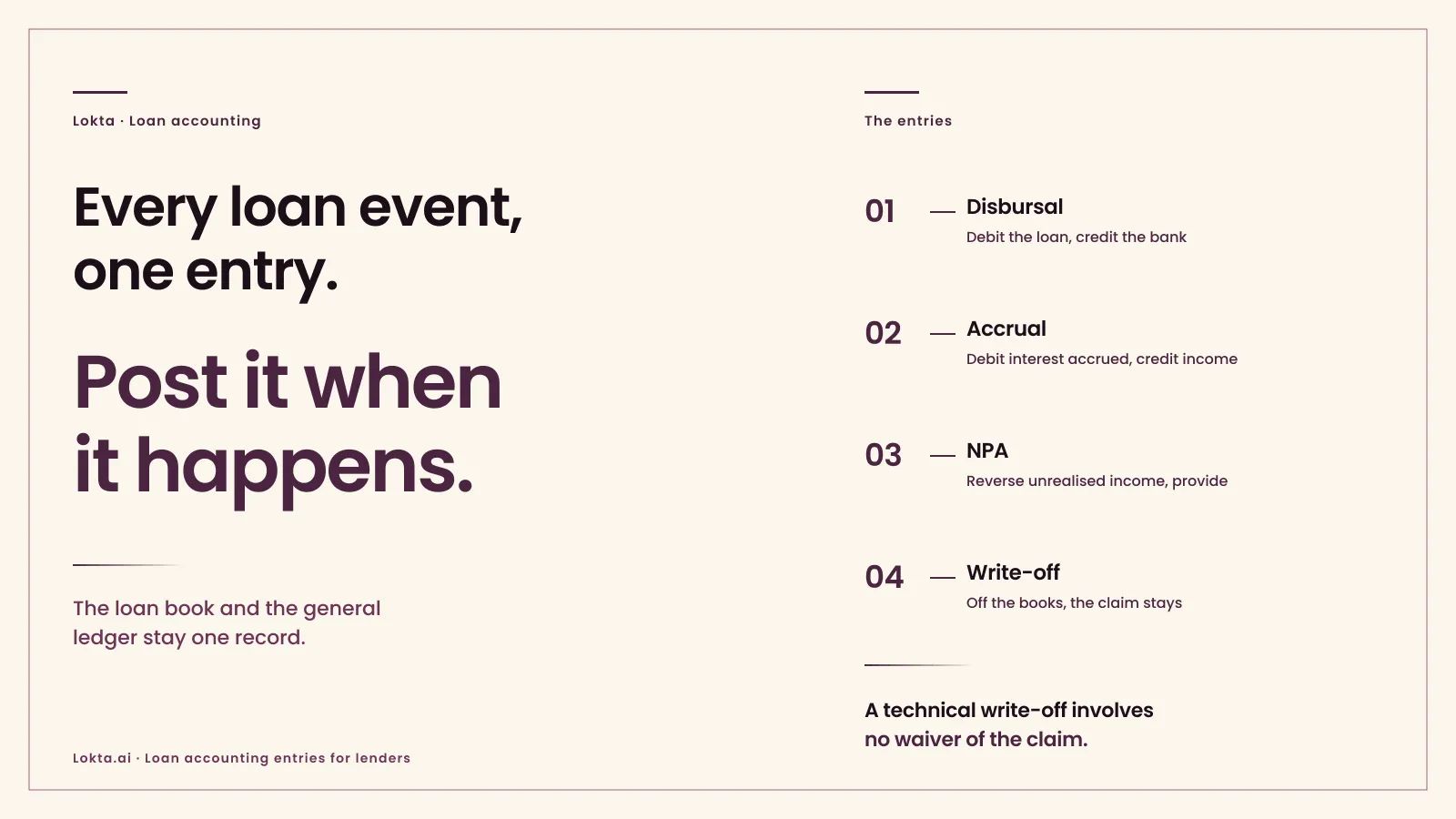
- Loan accounting entries for lenders: the debit and credit for each loan event, from disbursal to recovery after write-off.
- Loan subledger to general ledger reconciliation: one month-end close, tied out GL head by GL head.
- Ledger drift in loan servicing: why a book that reconciles can still be wrong, and how to test one product.
Sources
- RBI: NBFC Income Recognition, Asset Classification and Provisioning Directions, 2025, RBI/DOR/2025-26/356, 28 November 2025, updated as on 1 October 2026. Paragraph 8 (Ind AS prevails where inconsistent), 18-19 (day-end flags), 20 and 23 (borrower-wise classification), 34-35 (prudential floor and Impairment Reserve), 38 (income on NPAs)
- Ind AS 109, Financial Instruments, as published by ICAI. Paragraphs 5.4.1 (effective interest method) and 5.5.4 (individual or collective basis)
- RBI: NBFC Transfer and Distribution of Credit Risk Directions, 2025, Part B (co-lending). Paragraphs 102 and 116
- ICAI: Audit trail requirements and responsibilities, reproducing the Rule 3(1) proviso of the Companies (Accounts) Rules, 2014
Lokta editorial analysis by Chandramouli, co-founder and CEO.