Loan subledger to general ledger reconciliation: one month-end close, worked through
Your loan subledger and general ledger can agree in total and still hide breaks. Follow one NBFC month-end close, head by head, and see where the gaps come from.
Contents 8 sections
Here’s a scenario, not a customer. You run finance at an NBFC with 40,000 live loans. Your loan system holds each loan’s balance. Your general ledger holds the books. Every month end, you have to show they agree, and sign for it.
Our position: if your loan control accounts take manual journals with no loan event behind them, you’ll spend every close explaining those balances instead of reconciling them. The close below shows why.
A loan subledger to general ledger reconciliation checks that the loan system’s balances, added up by GL head, match the GL’s control accounts on the same date. Tie out each head on its own (principal, interest, charges, unapplied receipts, interest suspense where you use it, and provisions), then go loan by loan where a head is off. Name every break and give it an owner. Correct loans in the loan system where you can, not with a journal in the GL.
30 June: the totals agree
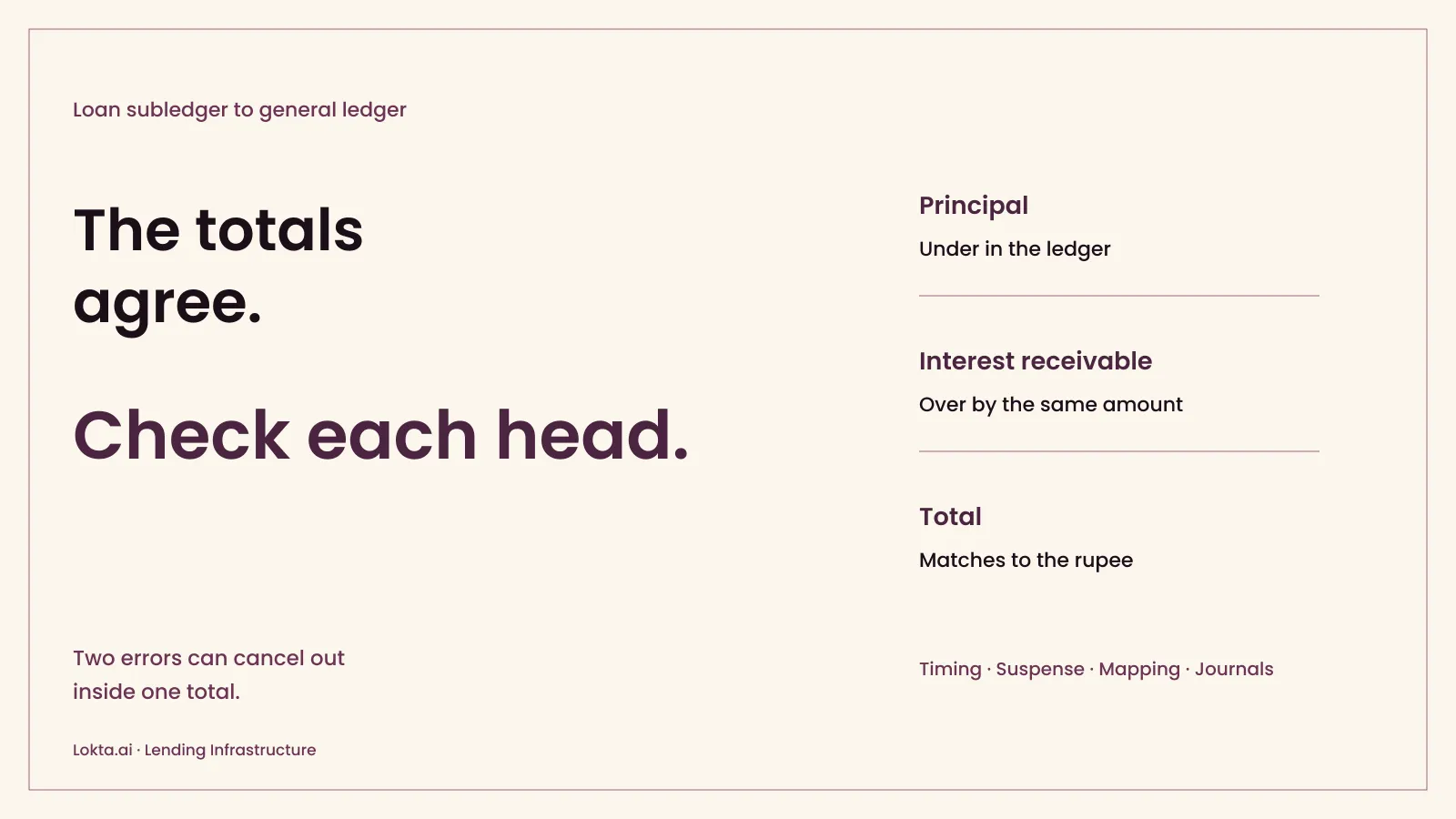
It’s 6 pm on 30 June. Your team pulls the loan system’s portfolio report and the GL trial balance. Principal and interest receivable together in the GL: ₹1,240 crore. The same 2 components in the loan system: ₹1,240 crore. They match to the rupee. Don’t sign yet.
Stopping here would miss an allocation error. A ₹4 lakh receipt reduced interest receivable in the loan system. In the GL, the entry debited the bank and credited principal. So GL principal is ₹4 lakh too low and GL interest receivable is ₹4 lakh too high. That’s 1 misallocation showing up as 2 differences, and the combined balance doesn’t move.
1 July: split the tie-out by GL head
On 1 July you split the comparison. You give each GL control account its own line, against the loan system’s figure for the same head and the same cut-off.
| GL head | What the loan system should show | Where it tends to go wrong |
|---|---|---|
| Principal outstanding | Sum of principal across live loans | Receipts allocated differently in the GL |
| Interest receivable and accrued | Interest due and accrued but not collected | Accrual run on a different date from the GL cut-off |
| Charges receivable | Bounce, penal and other charges due | A new charge type mapped to the wrong head |
| Unapplied receipts | Money received but not yet matched to a loan | Old items nobody has matched |
| Interest suspense | Unrealised NPA interest tracked separately, where you use this account | A reversal posted in one system and not the other |
| Provisions | Provision by account or by bucket | Portfolio-level entries made only in the GL |
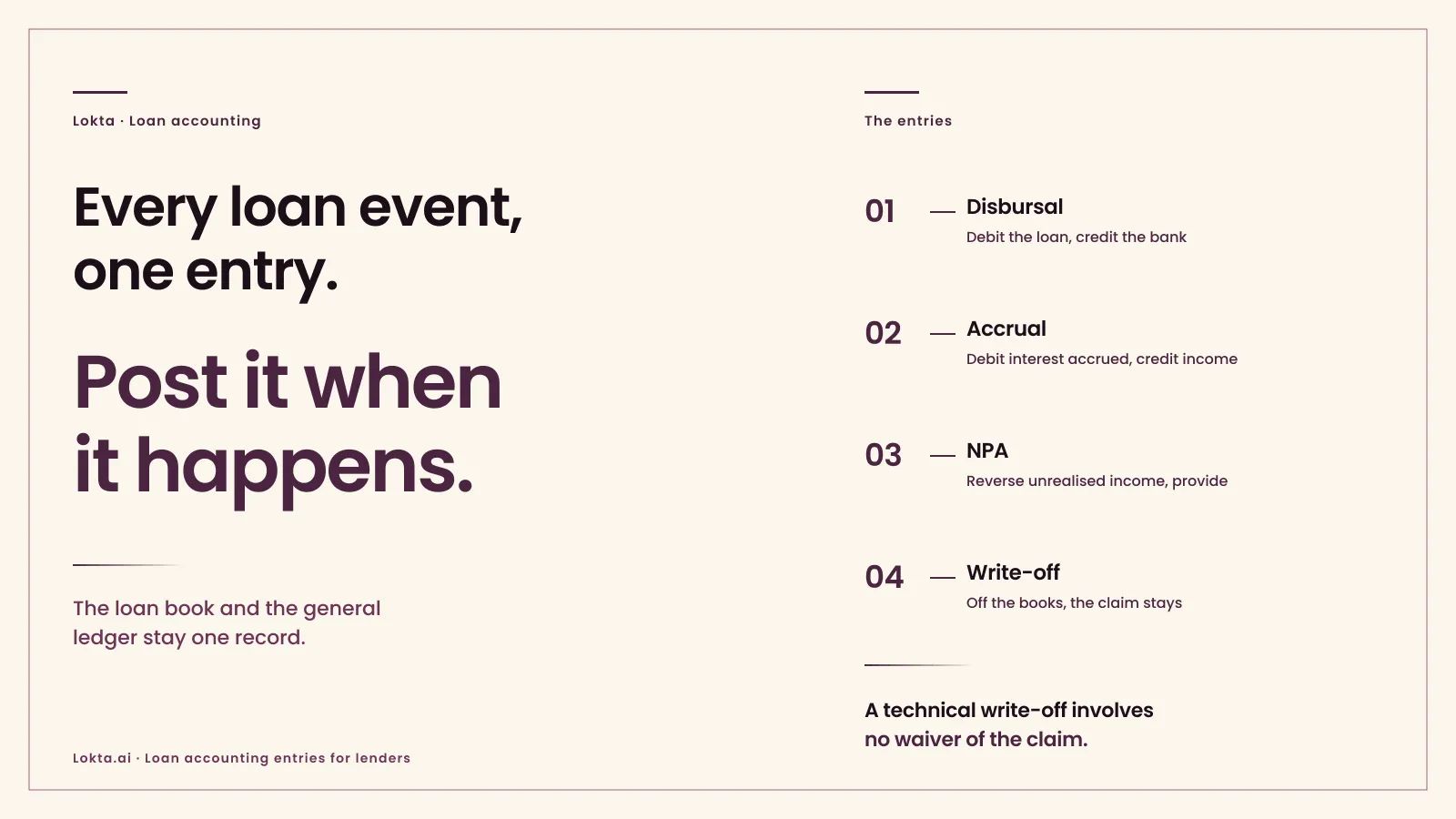
Interest suspense gets its own line for a reason. Paragraph 38 of RBI’s income recognition, asset classification and provisioning (IRACP) directions says income on an NPA counts only once it’s realised, and income booked before the slip that’s still unpaid has to be reversed. It doesn’t make you keep a suspense account. If you’ve got one, reconcile it on its own, because a reversal you’ve posted on one side only is a break. An Ind AS NBFC follows the standard where the two differ (paragraph 8): Ind AS 109 keeps recognising interest on a credit-impaired loan, at the effective rate on amortised cost (paragraph 5.4.1(b)). The entries for each case are in loan accounting entries for lenders.
That’s 6 lines where you had 1. In the scenario, 4 of the 6 heads agree. Principal and interest receivable are each off by ₹4 lakh, in opposite directions. Now you know where to look.
2 July: name every break
On 2 July you go loan by loan inside the 2 heads that are off. Before you name the ₹4 lakh, here’s the list we’d use. Keep it short and the names fixed, so the same break gets the same name next month. The examples are other breaks you might meet, not more differences in this close:
- Timing. An item’s in different periods: ₹38 lakh of UPI receipts are in the bank and the GL on 30 June, but in the loan system on 1 July. Write down the date you expect it to clear, then check that it did.
- Mapping or allocation. Your 2 sides don’t use the same GL mapping, or the same receipt allocation rule. A foreclosure charge added in May and never mapped is the classic case.
- Missing or duplicate postings. An event’s been left out, or posted twice, on either side. Think of a NACH return file loaded twice on a busy Monday.
- Backdated events. A ₹1.6 lakh reversal dated 28 June was entered on 3 July, after the GL closed. The loan system’s 30 June balance changed. The GL’s didn’t.
- Manual journals. Someone’s posted straight to a loan control account in the GL, with no loan event behind it.
Unapplied receipts aren’t on the list. If both sides agree on the balance, they aren’t a break. You’ll still want to look at the old items in that head every month. In the scenario there’s ₹11 lakh there, some of it from April. That’s a matching job for operations, with a deadline.
Your ₹4 lakh turns out to be the second kind. A receipt allocation rule changed in the loan system in June, and the extract that builds the GL entry still used the old one. You fix it with an approved GL entry: debit principal ₹4 lakh, credit interest receivable ₹4 lakh. Then you fix the extract. Each break you find gets an owner and a date. One without an owner is still open, whatever the sign-off says.
3 July: the manual journal nobody can trace
On 3 July a review of manual postings finds a ₹2.1 lakh debit and an equal credit on charges receivable, both dated March, with a narration that says “adj as discussed”. The head agrees in total. Neither posting’s got any evidence behind it, and nobody who’s still on the team remembers the discussion.
That’s the cost of a journal with no loan event behind it. You can’t tie it to a loan without rebuilding the story, so you carry it forward and explain it again next quarter. For financial years starting on or after 1 April 2023, Rule 3(1) of the Companies (Accounts) Rules, 2014 requires a company’s accounting software to record every transaction with an audit trail, log each change with its date, and stop anyone switching that trail off. Check that yours also shows who made each change. Even then, it won’t tell you which loans the journal was meant to fix, and that’s the question your auditor asks. More on that rule is in audit trail in a loan management system.
So we’d restrict manual postings to loan control accounts. Where a loan needs a correction, make it in the loan system as an approved adjustment with a reason, and let the GL entry follow from that event. Where a GL-only entry really is needed, it needs evidence, an approver and a written link to the loan balances or the calculation it adjusts.
Some entries really do belong only in the GL, and that’s fine. An Ind AS NBFC books its loss allowance under the expected credit loss model of Ind AS 109, often with portfolio overlays that don’t sit on any single loan. You reconcile that allowance to the approved ECL calculation. Then, separately, you compare it with the IRACP prudential floor. If the allowance is lower, RBI’s directions require the shortfall to be appropriated from profit after tax to an Impairment Reserve, which doesn’t count as regulatory capital (paragraphs 34 and 35). That reserve isn’t a loan loss allowance. Keep both on a short, documented list of known reconciling items, with the calculation and the approver attached. Don’t let that list grow into a hiding place.
The next close: tie out every day
Before you sign on 4 July, you check that the ₹4 lakh correction landed and you get evidence for the March postings. The allocation error was days old when you found it. The March journals were months old, even though the charges head agreed in total. The first was easy to trace. The second wasn’t, and it may never be.
So for the next close, move the tie-out by head from month end to every working day. If you find a break on the day it happens, its bank statement, its loan and its maker are still in reach. Month end then becomes one more checked cut-off, with most breaks already looked into.
You can run a daily tie-out from controlled extracts, or from postings each loan event creates. Either way, you’ll still check for missing, duplicate and wrongly mapped entries. You’ve got 3 ways to set it up:
- Tie out totals at month end. Least work. It’s also exactly how 1 misallocation, showing up as 2 differences that cancel each other out inside a single number, gets signed off by someone who’d never have signed it if they’d seen the split.
- Tie out by head every day from extracts. You keep your tools, which matters. It costs a nightly extract, a check that the extract matches the loan system, and someone who owns the breaks.
- Have the loan system create the postings. In Lokta’s loan management system, loan events create double-entry postings against the GL heads you’ve mapped, and finance signs that mapping. You’ll do the mapping work before go-live, for every product’s events, including reversals, write-offs and recoveries.
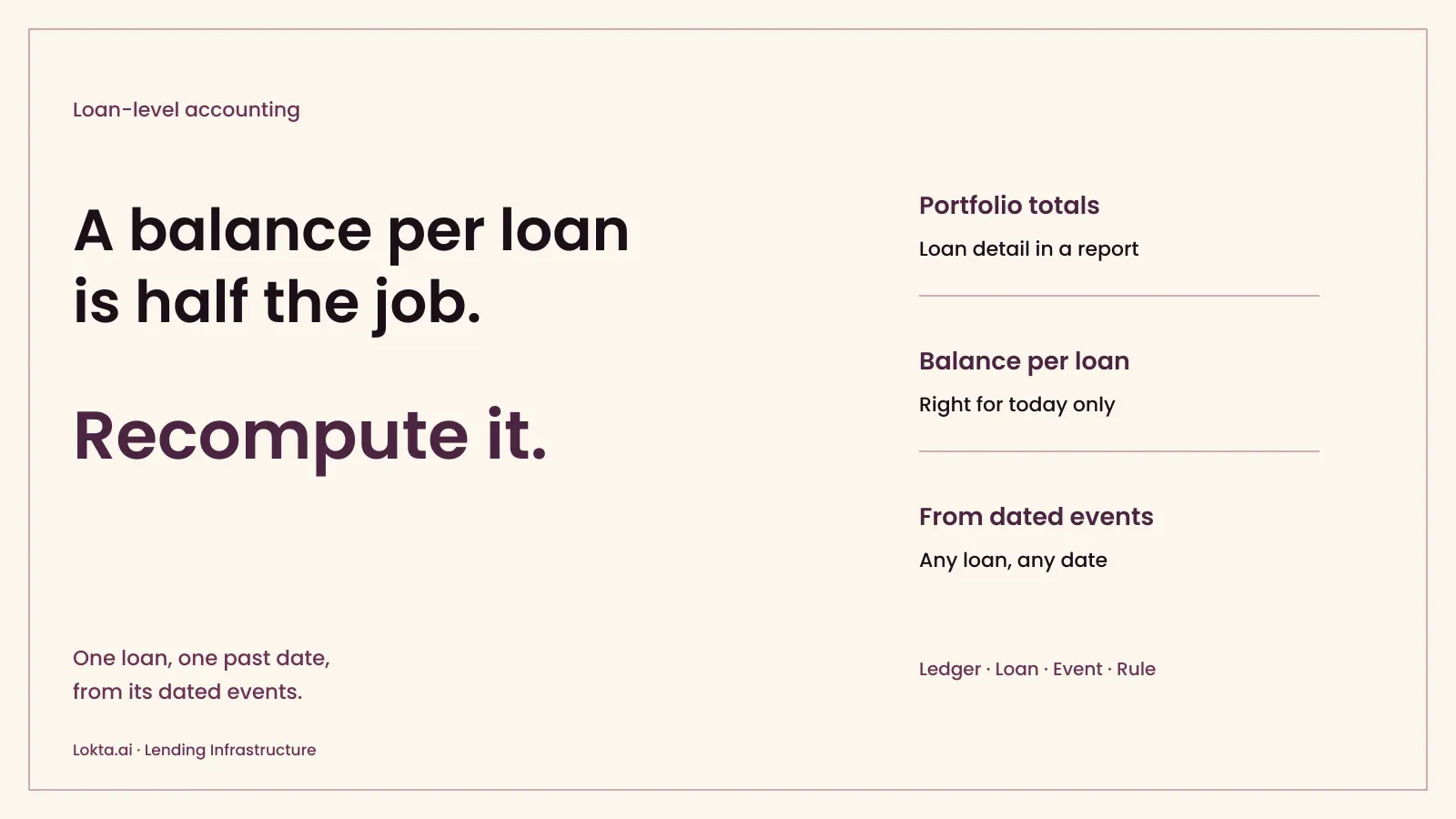
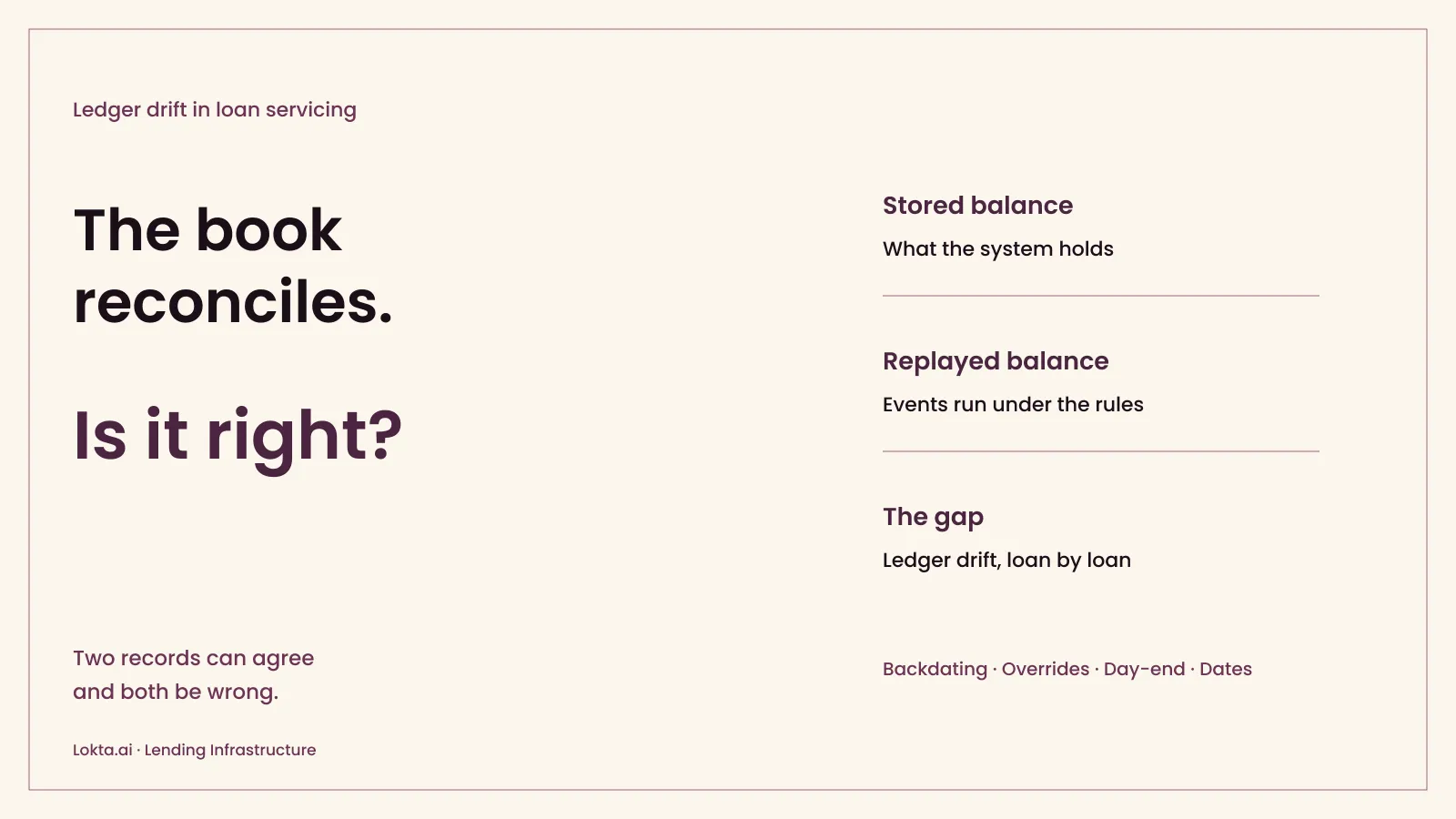
None of them tells you whether a balance that ties out was worked out right in the first place. That’s a different test, in ledger drift in loan servicing.
Talk to us about the GL heads you’d tie out first.
Frequently asked questions
What is loan subledger to general ledger reconciliation?
It's how you show that your loan system and your GL agree on the same date, head by head. You add up the loan system's balances by GL head (principal, interest receivable, charges, unapplied receipts, interest suspense if you keep one, and provisions) and compare each with its control account. Every gap gets a named cause, an owner and a date before you sign the close.
Why can the totals agree when the reconciliation is still wrong?
Because 1 misallocation shows up as 2 differences that cancel out. Say a ₹4 lakh receipt went to interest in the loan system and to principal in the GL. GL principal's ₹4 lakh low, GL interest receivable's ₹4 lakh high, and the total doesn't move. You'll only see it when you tie out head by head.
Should anyone post manual journals to a loan control account?
We'd restrict it. If a loan needs a correction, make it in the loan system as an approved adjustment with a reason, and let the GL entry follow from it. Some entries only exist in the GL, such as an Ind AS 109 expected credit loss overlay or an Impairment Reserve under RBI's IRACP directions. Each of those needs evidence, an approver and a written link to the calculation behind it.
How often should a lender reconcile the loan subledger to the GL?
At every month-end close, at minimum. We'd go daily if you can. A break you find on 3 July still has its bank statement, its loan and its maker in reach. One you find on 30 September often doesn't. You can run a daily tie-out from controlled extracts or from postings each loan event creates, and you'll still check for missing, duplicate and wrongly mapped entries.
Read next
- Loan accounting entries for lenders: the debit and credit behind each loan event
- Ledger drift in loan servicing: why a book that reconciles can still be wrong
- Audit trail in a loan management system: what the edit log has to record
Sources
- RBI: NBFC Income Recognition, Asset Classification and Provisioning Directions, 2025, RBI/DOR/2025-26/356, 28 November 2025, updated as on 1 October 2026. Paragraph 8 (Ind AS prevails where inconsistent), paragraphs 34 and 35 (prudential floor and Impairment Reserve), paragraph 38 (income recognition on NPAs)
- Ind AS 109, Financial Instruments, as published by ICAI. Paragraph 5.4.1(b) and section 5.5 (impairment)
- ICAI: Audit trail requirements and responsibilities, reproducing the Rule 3(1) proviso of the Companies (Accounts) Rules, 2014, applicable for financial years beginning on or after 1 April 2023
Lokta editorial analysis by Chandramouli, co-founder and CEO.