Ledger drift in loan servicing: why a book that reconciles can still be wrong
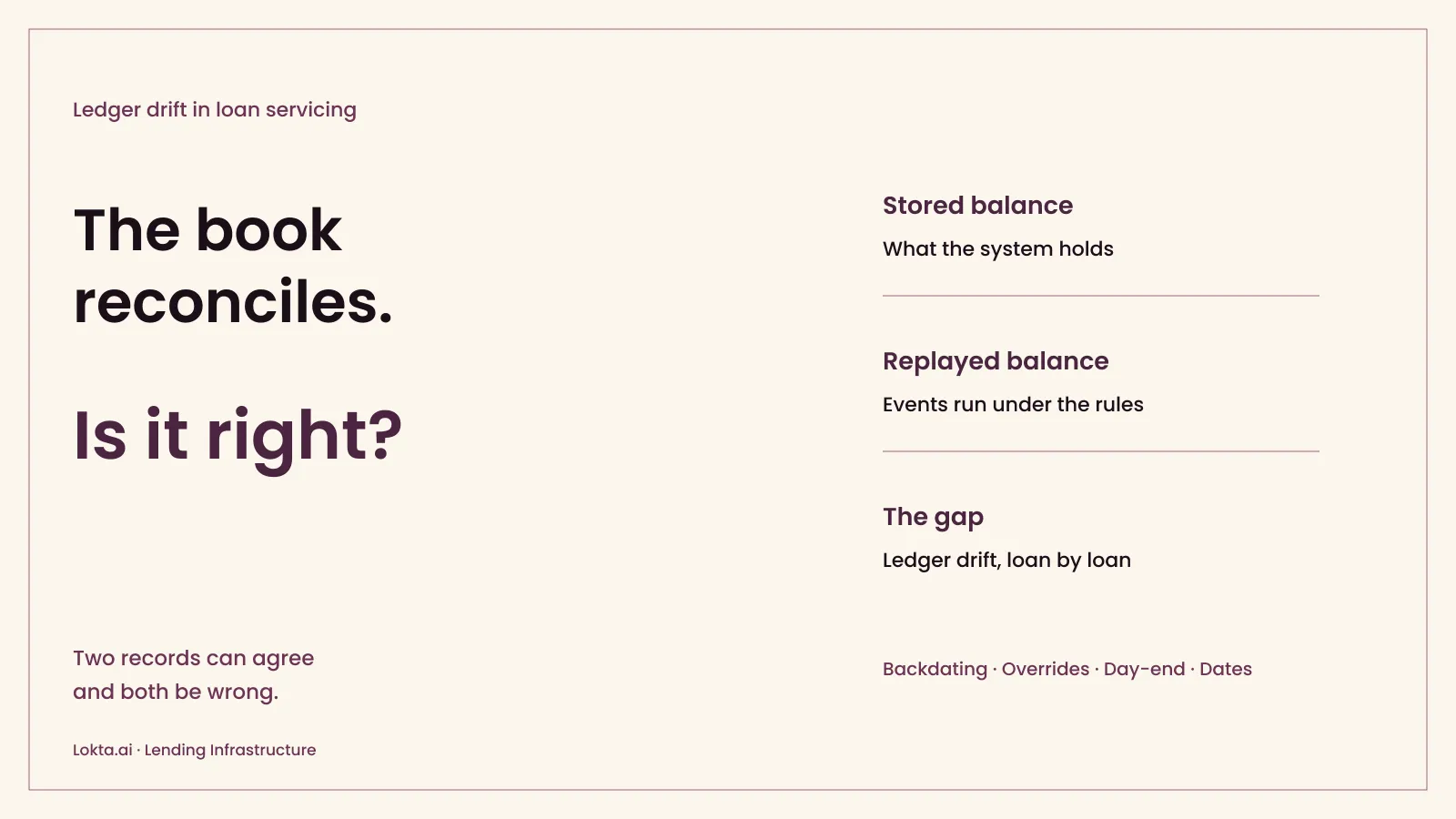
Ledger drift is a gap between a loan's stored balance and a balance recomputed from its own events and rules. Reconciliation can miss it. A replay can show it, with limits.
Contents 9 sections
A book that reconciles can still be wrong
If you sign off an NBFC’s loan book, here’s the hard part. Your book can reconcile every month and still be wrong. Reconciliation tells you two records agree, but it can’t tell you whether either one followed the rules your loan terms and your product setup call for.
You need to explain the sum behind a balance. A second, independent sum shows gaps a tie-out won’t. Lokta’s Drift Audit does that for 1 existing product: it compares replayed figures and reviews the gaps before you plan a move.
Ledger drift is a gap between your stored loan balance and one you recompute from the loan’s events and rules. Reconciliation can miss it, since two records can agree on one wrong posting. A replay can show it. But the same wrong rule gives the same wrong answer twice, so you still check sources.
Ledger drift is a gap between two calculations
Every loan is a list of dated events. Money goes out. Payments come in. Some bounce. Charges get added and waived. Take that list and the rules in force on each date, and you can work out the balance for any day.
That sum is only as good as what you feed it. Wrong dates in, wrong balance out, and no error message to tell you it happened.
So here’s our working definition. Ledger drift is a gap between the stored balance and one you recompute yourself, for the same date and loans. When the two agree, you still check the inputs.
Five places to look when a balance or status is wrong
We aren’t claiming how often these happen. Some leave a gap a replay shows. Others don’t.
| Where it starts | What goes wrong | What it can change |
|---|---|---|
| A backdated payment or reversal | The payment hits today’s balance. Interest and overdue days from the real date aren’t worked out again. | Interest, days past due, classification date |
| Interest from the wrong date | Interest runs from sanction or cheque date, or for a whole month on a mid-month event. | Interest charged, borrower dues |
| Day-end on the wrong date | The run uses the day it ran, not the business date it’s processing, or a missed day isn’t caught up under control. | Overdue, SMA and NPA dates |
| A hand edit | Someone changes a balance or a status by hand, with no recorded event or reason. | Classification, provisions |
| One borrower, two systems | Loans to the same borrower with your NBFC aren’t linked reliably across systems. | Borrower-level classification and upgrade checks |
A replay can’t catch the second row on its own. If interest ran from the wrong start date, your loan system and your general ledger both carry it. A replay with the same start-date rule agrees too. All three match. All three are wrong. You find it by checking the rule against the real disbursal record.
It’s real. In its 29 April 2024 circular (paragraphs 2 to 4), RBI said exams for the period ended 31 March 2023 found lenders charging interest from sanction, not disbursal. Some charged from a cheque’s date, though it was handed over days later. Some charged a whole month for a mid-month loan. Where supervisors found this, they advised refunds. RBI told lenders to fix their practices, with system changes where needed.
Here’s one illustration, not a customer. Take ₹2,00,000 at 24% a year, simple interest, Actual/365. It’s sanctioned on 1 March and paid out on 6 March. That’s 5 days before the money went out. Charging for them adds ₹2,00,000 × 24% × 5 ÷ 365 = ₹657.53, so about ₹658, on 1 loan. It isn’t a measured loss across any book.
A balance error can reach reporting and accounting
A wrong balance or overdue date can reach any record that uses that field. Trace the fields first. Then decide what to fix.
A wrong overdue date is one way in. RBI’s 28 November 2025 directions for NBFCs tie overdue, SMA and NPA dates to the day-end process for a given date (paragraphs 18 and 19). For an ordinary overdue instalment loan, SMA-1 is more than 30 and up to 60 days overdue, SMA-2 is more than 60 and up to 90, and NPA is more than 90. In RBI’s 12 November 2021 example, a loan due on 31 March that stays unpaid is SMA-1 on 30 April, SMA-2 on 30 May and NPA on 29 June. If the account stays overdue, a wrong first date can carry into each one. So ask: did your system use the right business date and payment history, even on the night the batch ran late? The full rules are in SMA and NPA classification for NBFCs.
Classification is borrower-wise, across the borrower’s facilities with your NBFC (paragraph 23). Clearing all arrears is needed for an upgrade, and some cases add conditions (paragraphs 24 to 26). If those loans sit in 2 systems, you need a reliable borrower link and shared inputs.
Then review provisions and income recognition under your framework, including Ind AS where it applies. Check bureau files and partner reports too.
The best argument against this, and where it holds
A CFO could fairly push back: “We already run transaction reconciliation, independent interest checks and a review of classification exceptions. What would a replay add?”
Fair. You may already catch all 5 rows. How much reconciliation proves depends on what it covers and what you do with exceptions. A replay earns its place only where it tests sums your controls don’t.
RBI saw the hand-edit version at banks. Its 14 September 2020 circular (paragraphs 2.8 and 2.9) said banks were “over-riding the system generated asset classification by manual intervention in a routine manner.” It allowed exceptional changes under controls: at least 2 levels of approval, and system logs kept for at least 3 years. It went to scheduled commercial banks (excluding RRBs) and small finance banks, not NBFCs. Still, the lesson travels. A correction can be right. Keep its reason, approval and evidence, so someone can check it.
Test it with a replay of one product
Don’t start with your whole book. Start small: 1 product, and a note of what you want the replay to test.
- Freeze a dated export of the stored balances and statuses you’re testing, with the loans, event histories, effective dates, posting times, schedules, rule versions in force on each date, and recorded adjustments. Replay from the first event where you can. If you can’t, check the opening position on its own and say the earlier periods sit outside the test. Note the gaps and keep the export.
- Check those inputs against source records and loan terms. Then recompute with the rules that applied on each date, using the same allocation order, rounding and day count.
- Compare at the same cut-off. If you’re checking classification, bring in the borrower’s other loans with you too.
- Look into each gap. Write down the cause where you’ve found it, and keep the open ones for review.
A match tells you your figures hang together within what you tested, which is useful but narrower than it sounds. A mismatch is something to look into, not proof of a cause.
A deterministic core gives you the same result from the same inputs and rules. That makes a sum testable, not right. It’s also why a loan ledger should never be model-guessed.
You’ve got 3 ways to go. You can keep reconciliation as it is and add independent checks where your controls leave a gap. You can bring 1 existing product to Lokta for a Drift Audit, which compares replayed figures and reviews the gaps before you plan a move. Or you can build your own replay and own its rules and exceptions for good. Whichever you pick, a replay needs clean data and reviewed rules. It can still repeat a wrong rule.
Talk to us about the product you’d replay first.
Frequently asked questions
What is ledger drift in loan servicing?
It's a gap between the balance your loan system stored and one you work out again from the same loan's events and rules, for the same date. A gap means you look. A match doesn't prove your data or rules were right.
Why doesn't monthly reconciliation catch ledger drift?
Reconciliation checks that two records agree. If one wrong posting reached your loan system and your general ledger, they still agree. Recomputing the balance, and checking inputs like the disbursal date against source records, tests what agreement can't.
What can ledger drift affect for an NBFC?
A wrong balance or overdue date can reach classification, provisions, income recognition, bureau files and partner reports. Some gaps won't change an account's status at all. Trace each field before you decide what to correct.
How do you test a loan book for ledger drift?
Start with 1 product. Export its loans, events and rule versions, check the inputs, recompute, and compare at one cut-off. Lokta's Drift Audit compares replayed figures for 1 existing product and reviews the gaps before you plan a move. Agree its scope first.
Read next
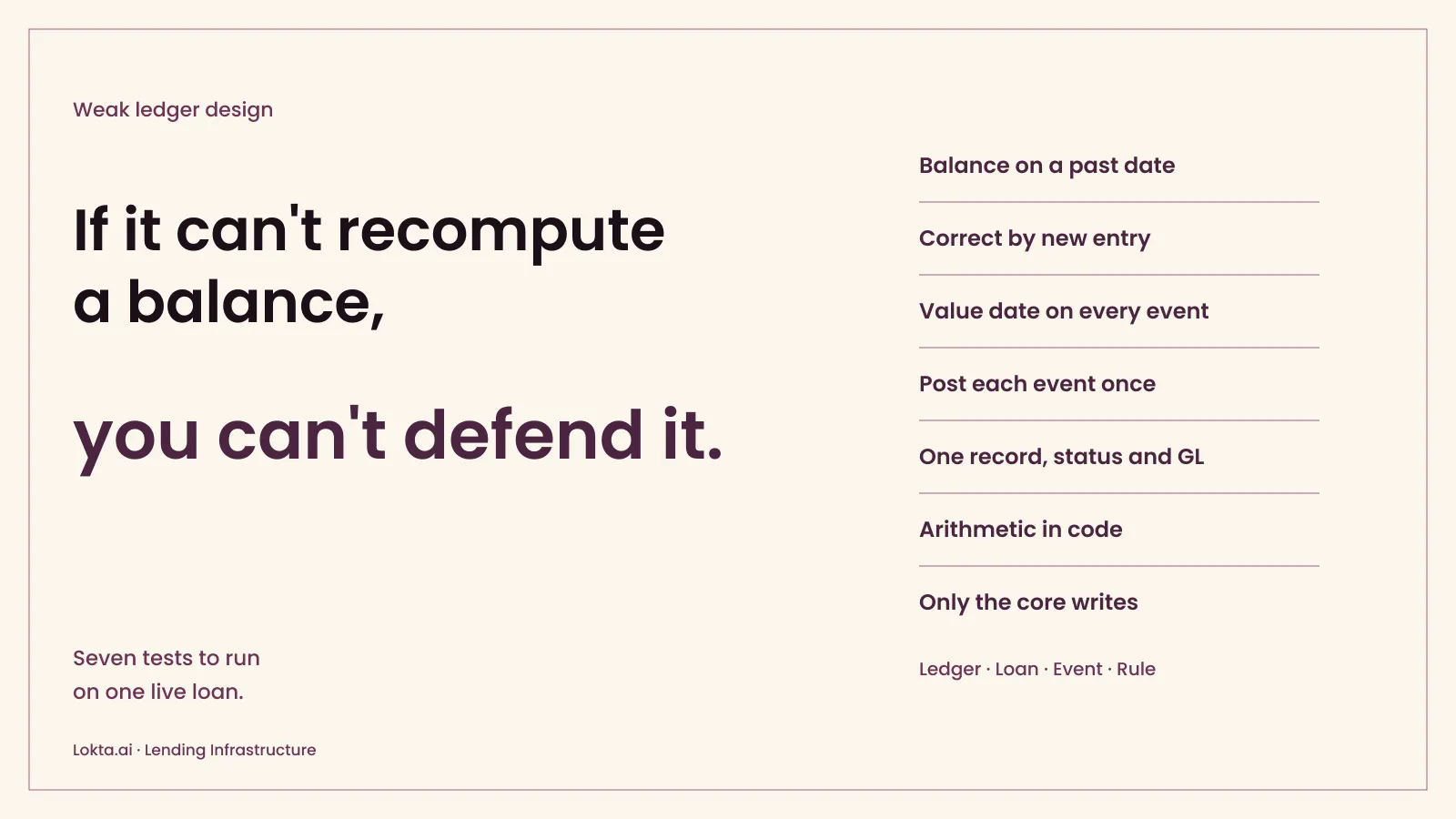
- What weak ledger design breaks in loan servicing: why ledger arithmetic has to give the same answer on every replay
- Interest accrual in a loan management system: how backdated events should re-run daily accrual
- Loan accounting entries for lenders: what each loan event should post to the general ledger
Sources
- RBI: NBFC Income Recognition, Asset Classification and Provisioning Directions, 2025, RBI/DOR/2025-26/356, 28 November 2025, updated as on 1 October 2026. Paragraphs 18-19 (day-end flagging and dates), 23 (borrower-wise classification), 24-26 (upgradation)
- RBI: Prudential norms on IRACP, clarifications, RBI/2021-2022/125, 12 November 2021. Paragraph 4 and its worked example
- RBI: Fair Practices Code for Lenders, Charging of Interest, RBI/2024-25/30, 29 April 2024. Paragraphs 2-4
- RBI: Automation of IRACP processes in banks, RBI/2020-21/37, 14 September 2020. Paragraphs 1, 2.8 and 2.9 (addressed to scheduled commercial banks excluding RRBs, and small finance banks)
Lokta editorial analysis by Chandramouli, co-founder and CEO.