PD, LGD and EAD: the expected credit loss formula, worked through for NBFCs
PD, LGD and EAD multiply into expected loss. Ind AS 109 then asks for 12-month or lifetime ECL by stage, and DPD history in the loan record decides the stage.
Contents 12 sections
If you sign off provisions at an NBFC, the expected credit loss formula is the easy part. Three numbers multiply: PD, LGD and EAD. What your auditor or model reviewer pushes on is whether you can show where each number came from, as it stood on the reporting date.
Our position: in a post-approval book, the ECL inputs deserve more of your control effort than the formula does. Ind AS 109 doesn’t write PD × LGD × EAD, and it doesn’t use the word “stage”. It asks for a discounted, probability-weighted estimate from reasonable and supportable information. For your live loan book, that information is DPD history, cures, recoveries, collateral values and write-offs, and it lives in your loan record.
PD (probability of default) is the chance a borrower defaults within a period, LGD (loss given default) is the share of the exposure lost when that happens, and EAD (exposure at default) is the amount owed at default. Expected loss equals PD × LGD × EAD. Under Ind AS 109, a loan with no significant increase in credit risk carries 12-month ECL, and one past that line carries lifetime ECL, with 30 and 90 days past due as rebuttable presumptions for the two thresholds.
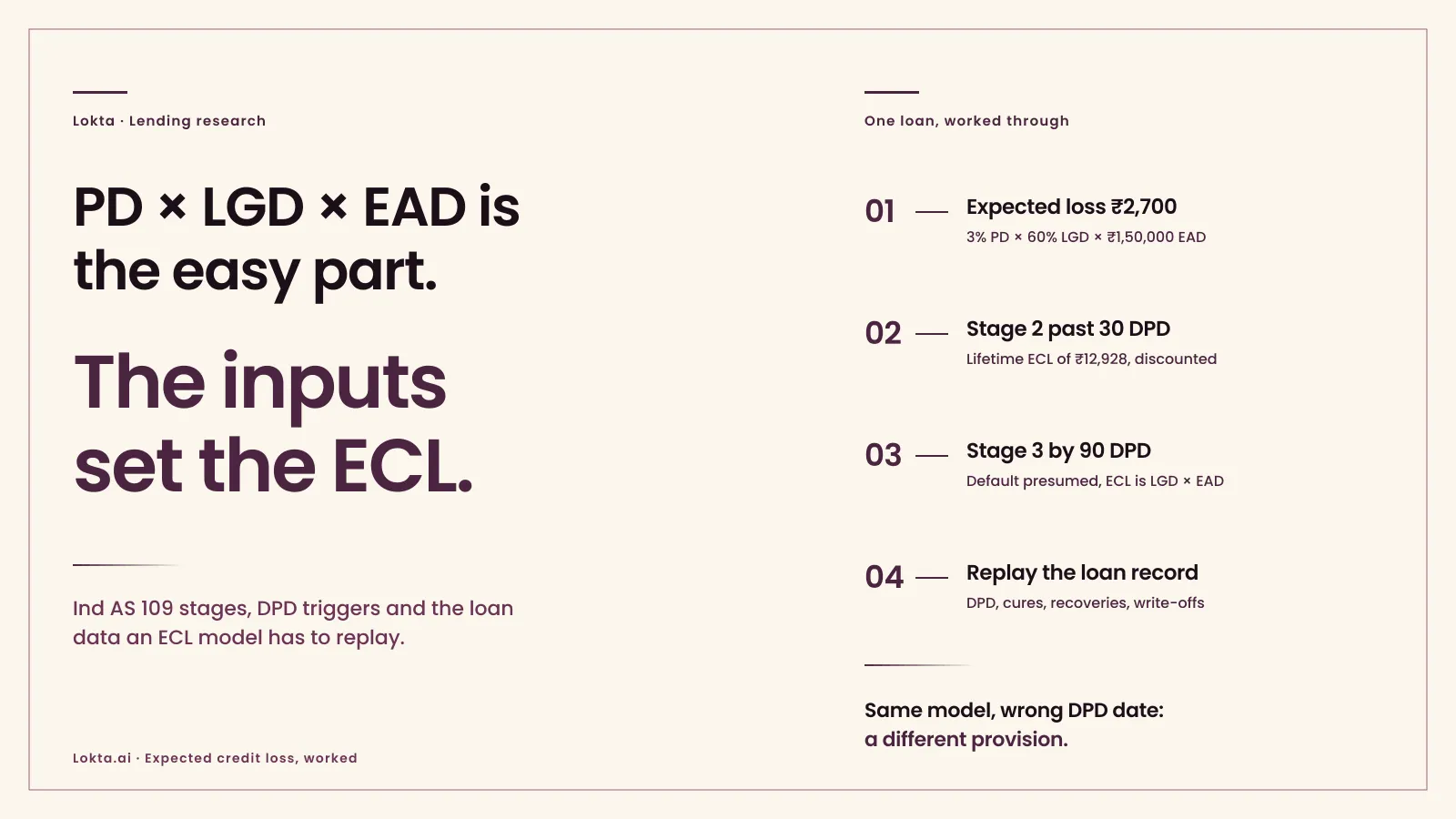
- The expected loss formula is PD × LGD × EAD. On a ₹1,50,000 exposure with a 3% PD and 60% LGD, expected loss is ₹2,700.
- Moving a loan from 12-month to lifetime ECL can multiply its provision. In our worked example the same loan goes from ₹2,288 to ₹12,928 after discounting.
- DPD decides the stage unless better information exists. Ind AS 109 presumes a significant increase in credit risk past 30 days past due and default by 90, both rebuttable with evidence.
- RBI’s ECL Directions apply to commercial banks from 1 April 2027. NBFCs on Ind AS already measure ECL under Ind AS 109, with RBI’s prudential provisioning as the floor.
- Every ECL input has to be replayable as of the reporting date. Your model risk reviewer should be able to re-run your number from the DPD, cure and recovery data behind it.
The worked figures below follow one labelled scenario. You’re carrying a personal loan with a ₹1,50,000 balance, an 18% effective interest rate (EIR) and three years left to run. Every input is an assumption we chose to show the arithmetic. None of it is a customer number or a benchmark.
What do PD, LGD and EAD mean?
PD, LGD and EAD are the three risk parameters you multiply to get expected credit loss. The Basel Committee’s 2005 explanatory note on the IRB risk-weight functions describes them as the share of borrowers in a grade expected to default over a year, the share of the exposure you might lose on default, and the amount outstanding at the time of default, including likely drawdowns on undrawn lines. So the PD full form in banking is probability of default, and LGD and EAD are its two partners.
A percentage over a stated horizon: 12 months, or the remaining life of the loan. Under Ind AS 109 it has to reflect past events, current conditions and forecasts (paragraph 5.5.17).
The share of EAD not recovered, after discounting recoveries and netting collection costs. It moves with collateral, borrower type and how well your workout goes.
The outstanding balance at the time of default, plus likely drawdowns on any undrawn limit. On an amortising term loan it falls with each EMI your borrower pays before defaulting.
What is the expected loss formula?
Expected loss equals PD × LGD × EAD. That’s it. The Basel note writes it as EL = PD × EAD × LGD in currency terms, or PD × LGD as a percentage of EAD. Here’s what our scenario loan gives while it’s current.
That’s one period, undiscounted. Ind AS 109 paragraph 5.5.17 asks for more: an unbiased, probability-weighted amount across a range of outcomes, the time value of money, and reasonable and supportable information about past events, current conditions and forecasts. Discount the ₹2,700 back one year at the 18% EIR and you’ll get a 12-month ECL of ₹2,288.
The formula is a convention rather than a rule. Paragraph B5.5.12 accepts approaches with no explicit PD, such as a loss-rate method, provided you can separate changes in default risk from changes in other drivers like collateral. The advantage of PD × LGD × EAD is that it keeps those drivers apart, so you can test each one on its own.
What is the difference between 12-month and lifetime ECL?
12-month ECL counts losses from defaults possible in the 12 months after the reporting date. Lifetime ECL counts losses from every possible default over the loan’s remaining life. Both definitions come from Appendix A of Ind AS 109. Paragraph 5.5.5 applies 12-month ECL where credit risk hasn’t increased significantly since you first recognised the loan. Paragraph 5.5.3 applies lifetime ECL where it has. Paragraph 5.5.19 caps the horizon at the maximum contractual period, including extension options.
Now suppose your scenario loan has slipped and its credit risk has increased significantly. Lifetime ECL adds up a PD × LGD × EAD term for each remaining year and discounts each one at the EIR. Paragraph B5.5.44 of Ind AS 109 says you discount to the reporting date, not the default date, at the effective interest rate set when you first recognised the loan. The yearly PDs here are unconditional (the chance of defaulting in that year, seen from today), and EAD falls as the loan amortises. To keep the arithmetic visible, we’ve used the balance at the start of each year and assumed the loss lands at year end. The balances are round assumptions, not an EMI schedule.
| Year | PD × LGD × EAD | Loss, then discounted at 18% |
|---|---|---|
| Year 1 | 12% × 60% × ₹1,50,000 | ₹10,800, discount factor 0.8475, present value ₹9,153 |
| Year 2 | 7% × 60% × ₹1,00,000 | ₹4,200, discount factor 0.7182, present value ₹3,016 |
| Year 3 | 4% × 60% × ₹52,000 | ₹1,248, discount factor 0.6086, present value ₹760 |
| Lifetime ECL | Cumulative PD of 23% | ₹12,928 |
Add up the rows and you’ll get ₹12,929. Each row is rounded to the rupee, and the ₹12,928 total comes from the unrounded values.
The same loan carried ₹2,288 while it sat in the 12-month bucket. After the move, you’re holding ₹12,928. Two things changed at once: the yearly PD rose from 3% to 12%, and the horizon stretched from one year to three. That’s why you’ll want at least as much evidence on file for the staging decision as for the PD curve.
What are stages 1, 2 and 3 under Ind AS 109?
Stages 1, 2 and 3 are the industry’s names for the three positions Ind AS 109 describes. The standard itself doesn’t use the word “stage”. RBI’s 2026 ECL Directions for commercial banks do, in paragraph 25, so if you’re a bank the vocabulary is now regulatory, and if you’re an NBFC it’s customary.
| Stage | What has happened since first recognition | Allowance and source |
|---|---|---|
| Stage 1 | No significant increase in credit risk | 12-month ECL, Ind AS 109 paragraph 5.5.5 |
| Stage 2 | Significant increase in credit risk, not credit-impaired | Lifetime ECL, paragraph 5.5.3; 30 days past due presumption, paragraph 5.5.11 |
| Stage 3 | Credit-impaired: one or more events have hurt expected cash flows | Lifetime ECL; credit-impaired defined in Appendix A; 90 days past due default presumption, paragraph B5.5.37 |
In stage 3 the default has already happened, so PD is 100% and ECL is LGD × EAD. If your scenario loan defaults with ₹1,52,000 owed, including accrued interest, a 60% LGD gives an allowance of ₹91,200.
How does DPD decide the stage?
Days past due (DPD) decides the stage whenever there’s nothing more forward-looking. Paragraph 5.5.11 of Ind AS 109 sets a rebuttable presumption that credit risk has increased significantly once contractual payments are more than 30 days past due. Paragraph B5.5.37 sets a rebuttable presumption that default happens no later than 90 days past due. Appendix A lists a breach of contract, “such as a default or past due event”, among the evidence that a loan is credit-impaired. Read together, they make 30 DPD the stage 2 line and 90 DPD the stage 3 line unless you’ve got evidence for a different one.
Three details you’ll meet in practice:
- Past-due status is a backstop, not the whole test. Paragraph 5.5.11 says you can’t rely solely on past-due information when forward-looking information is available without undue cost or effort. A sharp fall in the borrower’s bureau score, for example, can justify stage 2 before 30 DPD.
- The presumptions are rebuttable, with evidence. RBI’s bank Directions say the same in paragraphs 33-34, and add that a rebuttal “shall not be adopted in a routine or mechanical manner”. You’ll need reasonable and supportable information on file for each rebuttal.
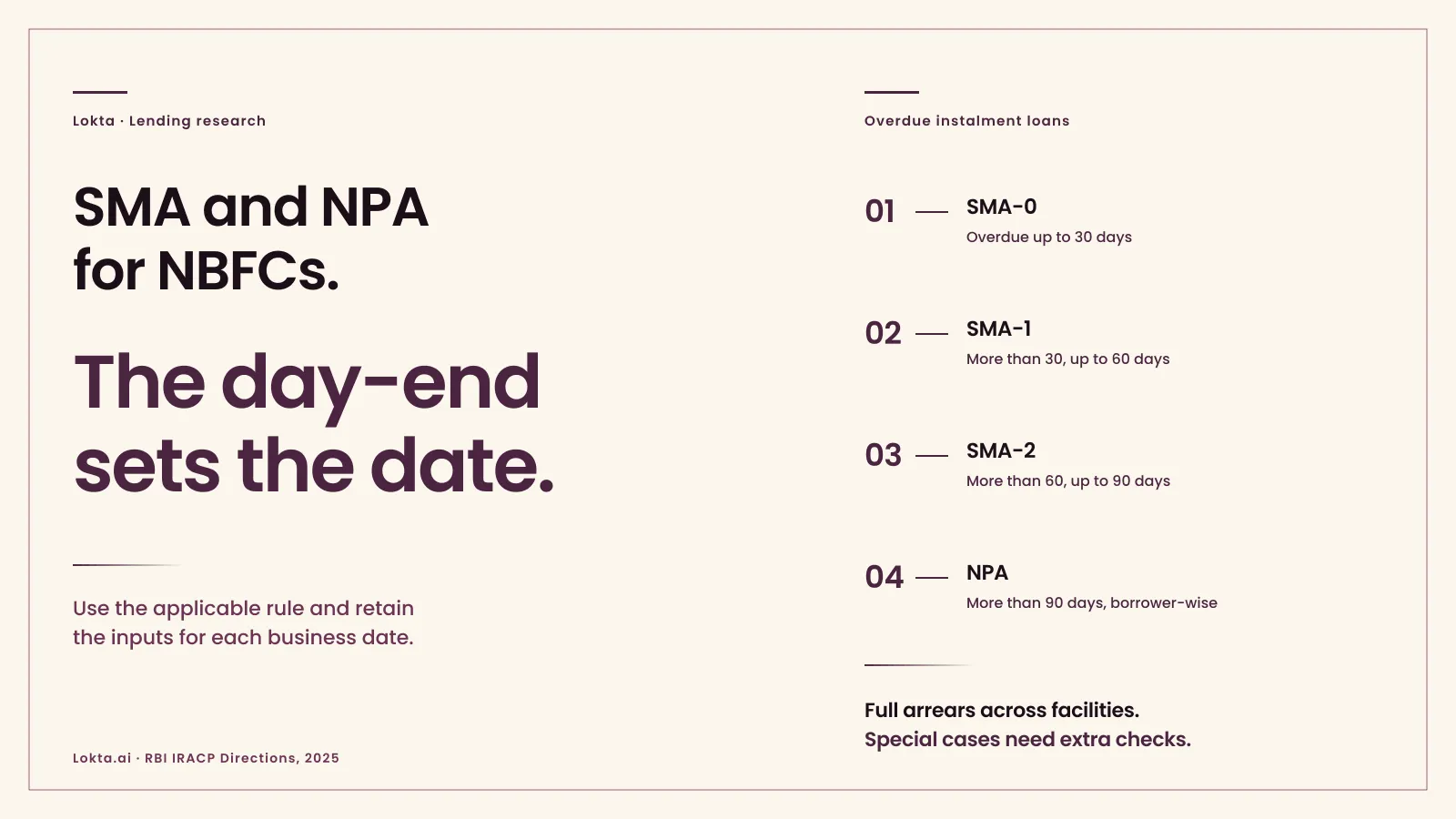
- The NPA line and the stage 3 line both sit at 90 days, as separate tests. For NBFCs, the NPA threshold under RBI’s IRACP Directions is now more than 90 days overdue across the layers, as our SMA and NPA classification guide sets out. They’re still two tests, and you’ll run both. For banks, the 2026 Directions define default as an NPA (paragraph 6(5)) and apply stage 3 at the borrower level, while stage 2 applies facility by facility (paragraph 76).
Your DPD is only as good as its date. Take the scenario loan at your 31 March close. Hold the scenario’s stage 1 and stage 2 inputs fixed. If the day-end process records the loan at 31 DPD, it carries ₹12,928. If a late-posted receipt or a batch run on the wrong business date leaves it at 29 DPD, and nothing else points to a significant increase in credit risk, it carries ₹2,288. The model didn’t change. The input did, and under these assumed inputs the provision moved by a factor of more than five.
What has RBI changed, and where do NBFCs stand?
RBI has moved commercial banks from incurred-loss provisioning to expected credit loss. It published draft Directions for scheduled commercial banks on 7 October 2025, took comments until 30 November 2025, and issued the final Reserve Bank of India (Commercial Banks - Asset Classification, Provisioning and Income Recognition) Directions, 2026 on 27 April 2026.
| Provision | What the 2026 Directions say | Paragraph |
|---|---|---|
| Who and when | Commercial banks, excluding small finance banks, payments banks and local area banks, from 1 April 2027 | 2, 4 |
| PD floor | 12-month PD of at least 0.03% | 96 |
| LGD | Estimated from the bank’s own history; 65% secured and 70% unsecured backstops where it cannot estimate reliably; a 30% regulatory LGD in that case for the secured portion backed by eligible collateral such as cash, gold and government securities; independent validation | 97-99 |
| EAD | Estimated by the bank, with credit risk mitigants not netted off | 100 |
| Transition | Loan portfolio fair-valued on 1 April 2027; part of the transition impact added back to CET1 from 4/5 in 2027-28 down to 1/5 in 2030-31 | 19, 108 |
If you’re an NBFC, you’re outside these Directions. If you follow Ind AS, you already measure ECL under Ind AS 109. RBI’s NBFC Income Recognition, Asset Classification and Provisioning (IRACP) Directions, 2025 have you hold Ind AS impairment allowances while keeping RBI’s own classification and provisioning in parallel as the prudential floor (paragraph 34). Where your Ind AS allowance comes in lower, paragraph 35 moves the difference from profit after tax to an Impairment Reserve. We found no separate RBI ECL direction for NBFCs as of 21 November 2026. Check rbi.org.in before you rely on that.
If you co-lend with a commercial bank, the bank rules still matter to you. From 1 April 2027 the bank stages its share of those loans under its own Directions, so you should expect requests for the DPD and recovery history behind them.
What data does an ECL model need from the loan record?
Your ECL model for a post-approval book needs each loan’s history, not its current balance. PD comes from how loans moved between DPD buckets and into default. LGD comes from what happened after default. EAD comes from the schedule and the balance on the date of default. Each of those is a dated event, and they’re all in your loan record.
| Input from the loan record | What the model uses it for | What goes wrong without it |
|---|---|---|
| DPD history by business date | Staging on the reporting date; PD from bucket movement and default events | You can’t re-run staging for a past quarter, and you’re rebuilding roll rates from month-end snapshots |
| Cure events | Splitting defaults into cures and workouts for LGD; re-staging after cure | Your cured loans vanish from the default history, so LGD reads high and PD reads low |
| Recoveries, dated and net of cost | Discounting recoveries to the default date for workout LGD | You can’t discount a recovery without a date, and costs you book elsewhere flatter recovery |
| Collateral values over time | Secured LGD; loan-to-value at default | You end up applying today’s valuation to a default from two years ago |
| Write-offs and post-write-off recoveries | Closing the workout so the final LGD is known | Your loss looks final at write-off, and later recoveries never reach your LGD dataset |
| Reschedules and modifications | Modification evidence; stage 2 triggers; EAD after the new schedule | A rescheduled loan looks current to you and stays in stage 1 |
Cure history shows how much your record moves LGD. Suppose 200 loans in one of your segments defaulted last year. Fifty cured, paying back to current, for a cure rate of 25%. The other 150 went to workout and recovered 35% of EAD in present-value terms. A simplified split, which treats a cure as no loss and ignores cure timing, costs and re-default, gives LGD = (1 - 25%) × (1 - 35%) = 48.75%. Now suppose your loan system kept no record of the 50 cures. Only the 150 workouts show up as defaults, so LGD reads 65%. Applied to the ₹1,52,000 stage 3 loan in place of the 60% assumed earlier, that’s the difference between ₹74,100 and ₹98,800. The same gap in the cure data also understates PD. Fifty defaults have gone missing.
Cure rate and roll rate are collections metrics before they’re ECL inputs. Our roll rate and cure rate guide shows how your collections team can measure them from the same history.
Why must ECL inputs be reproducible for model risk review?
Your model risk reviewer has to re-run your ECL number from its inputs and get the same answer. If you pulled the inputs from a loan system that only stores today’s state, last quarter’s inputs don’t exist any more. Nobody can check the number.
RBI’s 2026 bank Directions spell out what that looks like. Paragraph 123 asks that documentation capture all inputs, data and assumptions, PD, LGD and economic forecasts among them. Paragraph 130 asks for a documented model validation framework that includes version controls. Paragraph 99 asks for LGD to be validated by an independent team, with the rationale and method documented. These bind banks. They don’t bind NBFCs. We’d still read them as a fair description of what your auditor and board will expect, and RBI’s June 2026 draft guidance on model risk management would apply to NBFCs across the scale-based layers, as our read of the draft covers.
For your data, reproducible means three things:
- Dated as of the business date. Your DPD and classification for 31 March are the values the day-end process produced for 31 March, whenever it ran.
- Replayable. You can re-derive any loan’s DPD, balance and events on any past date from its history, not from a stored snapshot someone may have edited.
- Traceable. You can link each input in the ECL run back to the loan events that produced it, and each change to those events has an approver.
Lokta, the agentic loan servicing platform, covers the loan-record side of this for you. In Lokta Loan Management, DPD, bucket movement and SMA and NPA classification are derived from each loan’s dated events, a loan can be re-derived from its transaction history, and write-offs, settlements and reschedules pass through maker-checker. Lokta RBI Model Risk Management keeps models, rules and scorecards in one inventory with owners, risk tiers, validation records and four-eyes approvals on an append-only evidence ledger. Lokta doesn’t compute your ECL. Your risk and finance teams own the PD, LGD and EAD models and the judgement inside them.
Three ways to feed the ECL model
The first way: you take a month-end extract into a spreadsheet or a separate risk workbook. It’s quick to start, but you can only re-run a past quarter if someone saved that quarter’s extract and nobody’s touched it since.
The second way: your ECL model reads from an event-based loan record. Staging, cures, recoveries and write-offs come from the same dated history your servicing team works on, so you can replay any reporting date. It’s the path we’d defend in front of a model risk reviewer. The trade-off: it makes your inputs reproducible, but it doesn’t build your PD or LGD model, and moving an existing book onto it is a migration project with its own reconciliation work.
The third way: you build a dedicated risk data warehouse that snapshots every loan every day. You can reproduce any date, but you’re paying for a second copy of the book that someone has to reconcile to the ledger every month.
Whichever you choose, the same number feeds pricing. Expected credit loss is the risk adjustment in RAROC, so a staging error moves the return you think a cohort earns as well as the reserve. If you want to see a loan from your book replayed from its transaction history, talk to us.
Frequently asked questions
What is the PD full form in banking?
PD stands for probability of default: the chance that a borrower defaults within a set period, typically one year. It sits beside LGD (loss given default, the share of the exposure you lose once a default happens) and EAD (exposure at default, the amount owed at that point). Multiply the three and you get expected loss. A 3% PD, 60% LGD and ₹1,50,000 EAD give ₹2,700.
What is the loss given default formula?
LGD is 1 minus the recovery rate, where the recovery rate is the present value of what you recover after default, net of collection costs, divided by EAD. If your record keeps cures, a simplified split treats a cure as no loss: LGD equals (1 minus the cure rate) times (1 minus the recovery rate on loans that don't cure). With a 25% cure rate and 35% recovery on the rest, LGD is 48.75%. Drop the cure history and the same book shows 65%.
How do you calculate expected credit loss under Ind AS 109?
Ind AS 109 asks for a probability-weighted, discounted estimate built on reasonable and supportable information (paragraph 5.5.17). For a loan with no significant increase in credit risk, you measure 12-month ECL (paragraph 5.5.5). Once credit risk has increased significantly, you measure lifetime ECL (paragraph 5.5.3). PD times LGD times EAD, summed by period and discounted at the effective interest rate, is one way to build that number, and paragraph B5.5.44 sets the effective interest rate as the discount rate. The standard doesn't prescribe a formula (paragraph B5.5.12).
Does RBI's expected credit loss framework apply to NBFCs?
RBI's ECL Directions of 27 April 2026, effective 1 April 2027, apply to commercial banks and exclude small finance banks, payments banks and local area banks. They don't cover NBFCs. An NBFC that follows Ind AS already measures ECL under Ind AS 109, and RBI's NBFC IRACP Directions make prudential provisioning the floor, with any shortfall moved to an Impairment Reserve (paragraphs 34-35).
Where does expected credit loss fit in RAROC?
RAROC, risk-adjusted return on capital, is income minus funding cost, operating cost and expected credit loss, divided by the capital you allocate to the loans. Expected credit loss is the risk adjustment, so a PD, LGD or EAD error flows straight into the return you think a cohort earns. Our RAROC worked example shows the full calculation with servicing costs.
Read next
- SMA and NPA classification for NBFCs: the DPD clock, day-end dating and the 90-day NPA line that sits beside stage 3.
- Roll rate and cure rate: the collections metrics that become PD and LGD inputs.
- Loan pricing and RAROC after servicing costs: where expected credit loss enters the return on a cohort.
Sources
- ICAI, Ind AS 109, Financial Instruments: paragraphs 5.5.3, 5.5.5, 5.5.11, 5.5.17, 5.5.19, B5.5.12, B5.5.37 and B5.5.44, and the Appendix A definitions of 12-month expected credit losses, lifetime expected credit losses and credit-impaired financial asset.
- Basel Committee on Banking Supervision, An Explanatory Note on the Basel II IRB Risk Weight Functions, July 2005, section 2: the definitions of PD, LGD and EAD, and EL = PD × EAD × LGD.
- RBI, Commercial Banks - Asset Classification, Provisioning and Income Recognition Directions, 2026, RBI/DOR/2026-27/398, 27 April 2026: paragraphs 2, 4, 6(5), 19, 25, 33-34, 76, 96-100, 108, 123 and 130.
- RBI, Connect 2 Regulate: draft Directions for scheduled commercial banks, 7 October 2025, comments due 30 November 2025.
- RBI, NBFC Income Recognition, Asset Classification and Provisioning Directions, 2025, RBI/DOR/2025-26/356, 28 November 2025, updated as on 1 October 2026: paragraphs 34 and 35.
Lokta editorial analysis by Chandramouli, co-founder and CEO.