Compliant loan servicing software in India: the RBI rules it has to support
No loan servicing software is RBI compliant on its own. The lender stays accountable. Here is a map of the RBI rules your servicing system has to support in 2026, and a test for each.
Contents 13 sections
Start from the rule, not the vendor
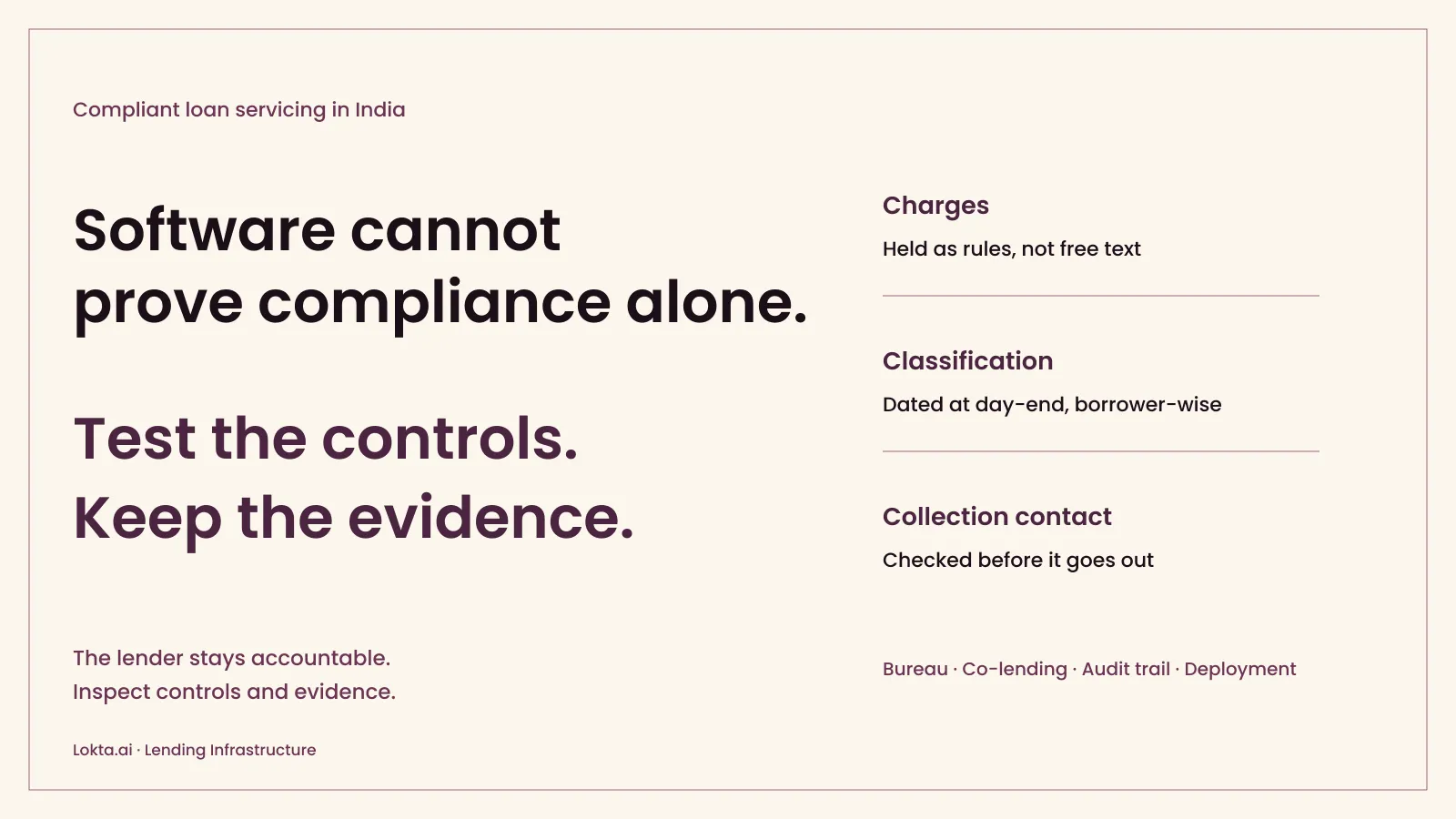
No loan servicing software is RBI compliant on its own. RBI regulates you, the lender, and you stay accountable for your book, your agents and your partners. Software can help you meet a rule. It can’t meet it for you, and we’d be wary of any vendor that says it can.
If you own servicing controls at an NBFC, here’s your map. It covers 8 rule areas for 2026, the control to look for in each, the evidence to keep, and a test you can run in a demo. Your compliance team confirms which rules apply to your layer and products before you test anything. That’s step zero.
Check servicing software against the rules that apply to your NBFC’s category, products and partners. This map covers 8 areas: charges, classification, collections, bureau files, co-lending, digital lending, audit trails and deployment. Some controls stop an action. Others detect, report or record it. You stay accountable, and passing these tests doesn’t prove you’re fully compliant.
Hold every charge as a rule
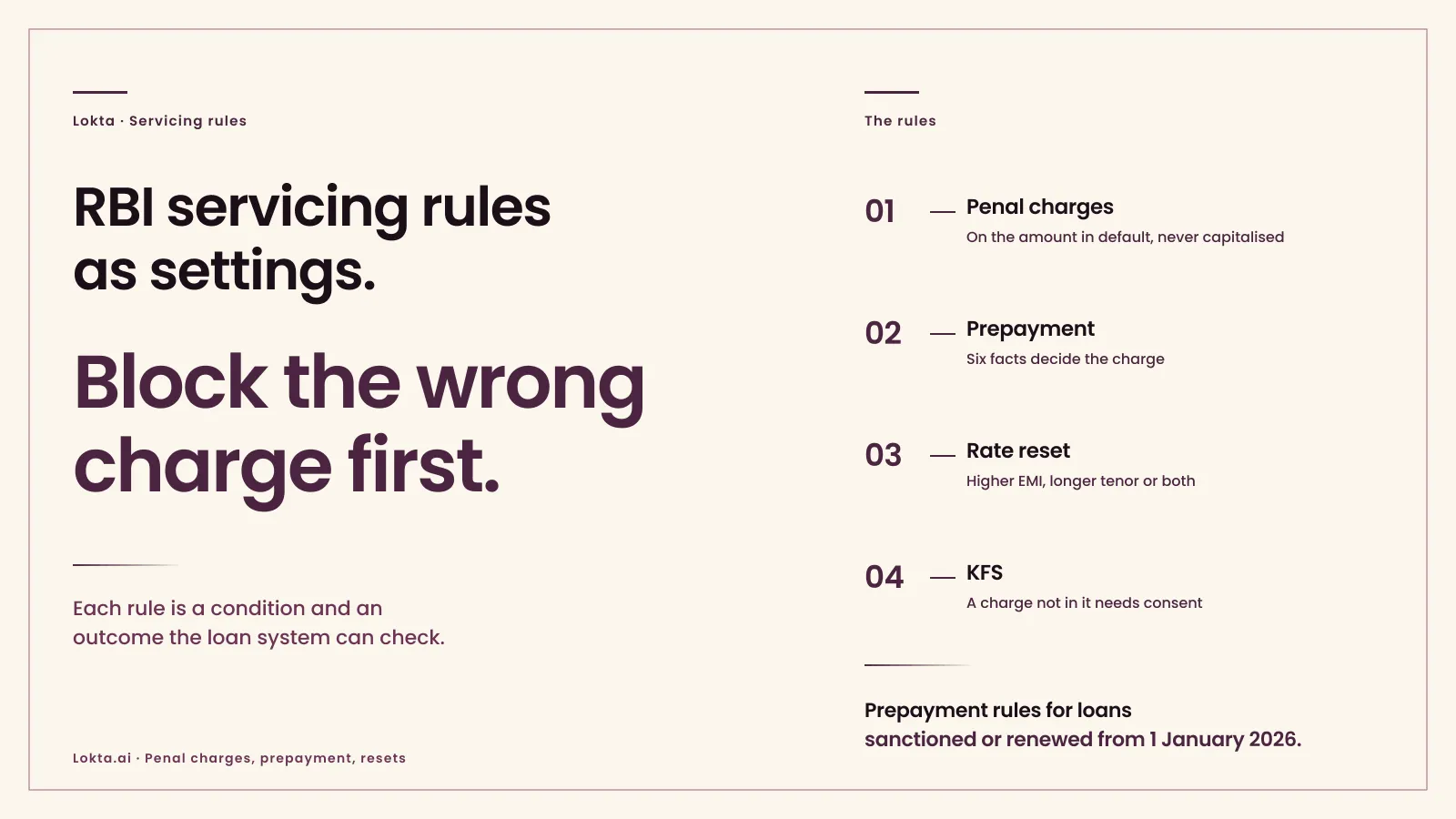
RBI’s rules on penal charges, prepayment charges and floating rate resets on EMI-based personal loans now sit in the Responsible Business Conduct Directions, 2025. Each one turns on conditions you’ll recognise: rate type, borrower, purpose, your layer, sanctioned amount and sanction date.
Here’s one. For loans sanctioned or renewed from 1 January 2026, you can’t charge for prepaying a floating rate loan to an individual for a non-business purpose, in any layer. Separately, for retail and MSME term loans sanctioned from 1 October 2024, a charge left out of the Key Facts Statement needs the borrower’s explicit consent. Credit card receivables are excluded. And consent can’t make a banned prepayment charge allowed.
You want those conditions held as product settings, so a banned charge can’t post. Here’s your test: try to post that prepayment charge, and you should see it fail. Then you’ll want to test a penal charge and a rate reset on their own. The full rule set is in penal charges, prepayment and rate resets as LMS configuration.
Classify on the right date, borrower by borrower
Check your NBFC category and the exposure’s own rules before you lean on this example. RBI ties overdue, SMA and NPA dates to the day-end process for a given date. In RBI’s own example, a loan due on 31 March that stays unpaid is SMA-1 on 30 April, SMA-2 on 30 May and NPA on 29 June. Classification is borrower-wise, across the borrower’s facilities with you.
Your system should use the business date it’s processing, even when your batch runs late. Here’s your test, on an ordinary overdue instalment loan: run day-end late and check the classification date. Then make 1 facility NPA and see what you get on the borrower’s other loans. Clear all arrears and check you get the upgrade. The rules are in SMA and NPA classification for NBFCs. Why a book that reconciles can still carry the wrong date is in ledger drift in loan servicing.
Check each collection contact before it goes out
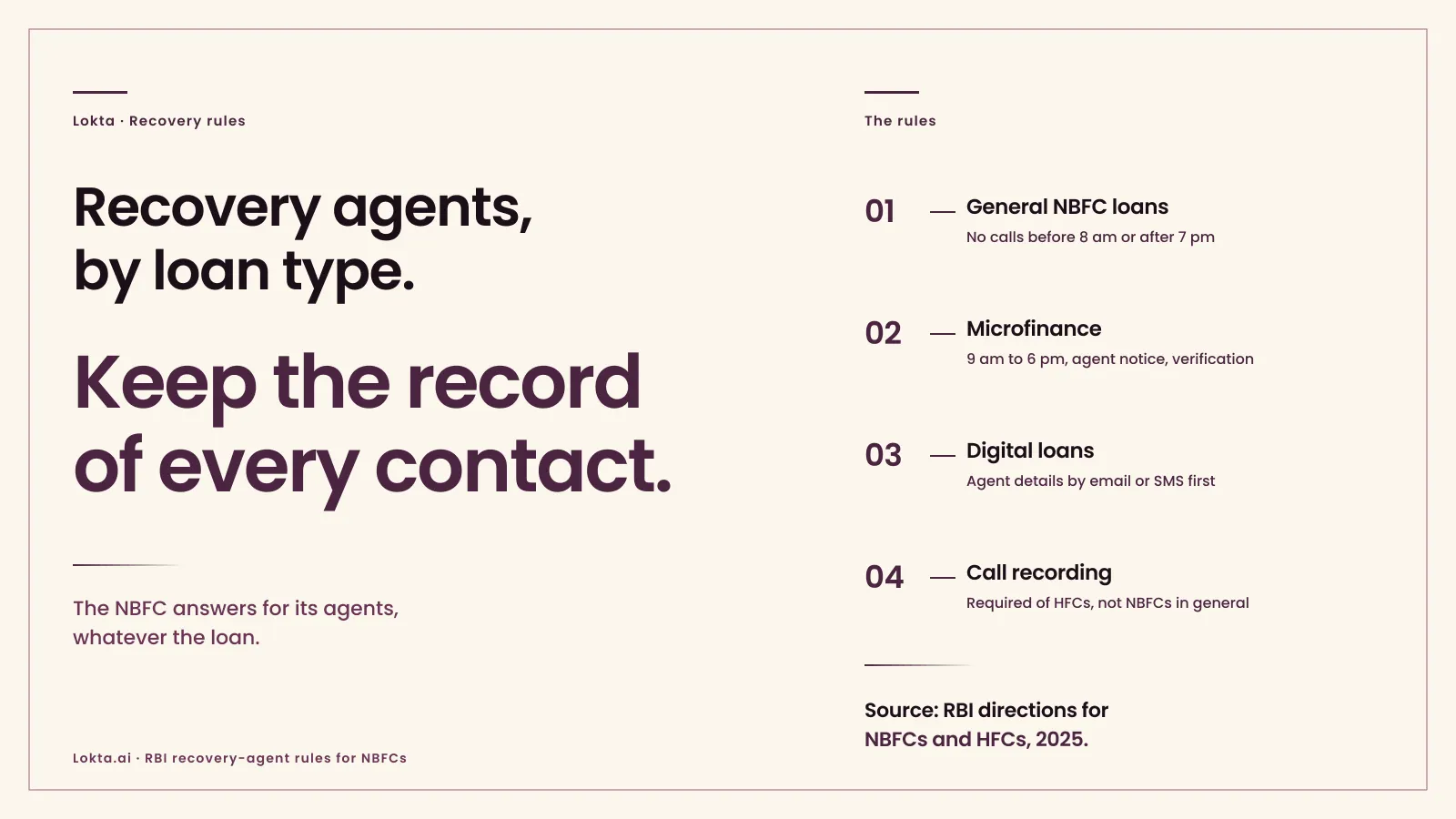
Paragraph 100 of the Responsible Business Conduct Directions bars recovery calls before 8 am or after 7 pm on NBFC loans other than microfinance. Microfinance has a stricter window, 9 am to 6 pm. Digital loans add a notice naming the recovery agent before contact. And you answer for your agents every time.
None of that changes when an AI agent makes the call for you. We’d say your system should check the hour and the notice before a recovery call starts, and log every contact. If you also limit messages to set hours, that’s your own policy, so test it as a separate control. Here’s your test: try an overdue-loan recovery call at 7:30 pm. You should see it refused. Then you test microfinance on its own. More in RBI recovery-agent rules for NBFCs and AI in loan collections under RBI’s rules.
File with the bureaus four times a month
Since 1 July 2026, your reporting dates are the 9th, 16th, 23rd and month-end. Each mid-month file holds accounts opened or closed since the last date, accounts changed by a borrower’s action or a transaction, and accounts with overdue interest or principal. That includes overdue accounts where only the days past due moved. You’ve got 4 calendar days from each date to send it. The full month-end file goes by the next month’s 5th day. Fix rejected records and resubmit them before, or along with, your file for the next date.
You’ll want every file built from your same loan record, with rejections tracked until they close. Here’s your test: include an account where only the days past due changed. Then load a rejection and follow its fix, resubmission and acknowledgement. Details in credit bureau reporting for NBFCs.
Keep co-lending partners in step
For NBFCs, the co-lending rules now sit in Part B of the Transfer and Distribution of Credit Risk Directions, 2025. Check the arrangement’s start date and transition rules first. For arrangements they cover, each lender keeps at least 10% of the loan, and both shares get booked without delay, within 15 calendar days of disbursal. Money moves through escrow. A default on a co-lent loan means matching borrower-level classification within the arrangement, shared near real time and by the end of the next working day at the latest.
Your system should split each receipt by your agreed shares and pass status changes to your partner on time. Here’s your test: allocate a receipt under the agreement, then trigger a default-based status change and check the partner’s acknowledgement. More in RBI’s co-lending rules after disbursal.
Evidence digital loans after disbursal
For NBFCs, the digital lending rules sit in Chapter III of the Credit Facilities Directions, 2025, and many still bite after disbursal. Your ordinary digital repayments have to reach you directly, with no lending service provider’s pass-through account in between. Employer repayments of salary advances, co-lending flows and cash recovery of overdue loans have their own provisions.
Your servicing record should also support the cooling-off exit, data held in India, and the reporting of each digital lending app you deploy or join on RBI’s CIMS portal. Our linked guide covers these, and why you answer for your service providers. Here’s your test: trace an ordinary digital repayment from bank evidence to the loan posting, and test any exception route on its own. Then work out and complete a cooling-off exit inside the window. Read RBI digital lending rules for NBFCs.
Keep a trail nobody can switch off
This one comes from company law, not RBI. Since the 2023-24 financial year, under the Companies (Accounts) Rules, companies that keep their books in accounting software must use software with an audit trail that logs each change with its date and can’t be switched off. RBI’s 2026 technology directions add audit trail duties for Middle Layer and larger NBFCs (other than Core Investment Companies), and Base Layer NBFCs with assets of ₹500 crore and above.
If your loan system holds your loan ledger, the trail may need to start there. Work out which software keeps your books, and agree the scope with your statutory auditor. You’re still responsible. Here’s your test: correct a charge, then look at both entries. Ask them how privileged access and logging are controlled. Read the audit trail in a loan management system.
Pick a deployment you can audit and exit
For material IT outsourcing by Middle, Upper and Top Layer NBFCs, Chapter IV of the Managing Risks in Outsourcing Directions, 2025 covers oversight of the provider, audit access, continuity and exit. That chapter doesn’t apply to Base Layer NBFCs, which should check their own technology rules. A hosting label proves none of this, whether it says on-prem, VPC or cloud. So don’t treat the label as your answer.
Here’s your test: ask for the outsourcing assessment, audit rights you can actually use, a sample data export, and the latest recovery test report with the times achieved, the data lost and any open findings. See on-prem, VPC or cloud for your LMS.
Two drafts are worth watching. RBI’s June 2026 model risk draft proposes telling customers when they’re dealing with AI and giving them access to a person. Its July 2026 data governance draft proposes tracing data from capture to report. As of 14 November 2026 they’re both still drafts, so you can plan for them, but don’t mix them up with binding rules.
The checklist
Copy this into your evaluation. They’re our suggested tests, not extra RBI rules. You run them on synthetic data, the same way for every vendor, and you keep what you get.
| Rule area | Suggested control to verify | Test in the demo |
|---|---|---|
| Charges | Penal, prepayment and reset conditions held as settings | Try the banned prepayment charge; test penal charges and a reset on their own |
| Classification | SMA and NPA dated at day-end, borrower-wise | Run a late day-end; make 1 facility NPA and check the borrower’s others |
| Collections | Calling hours and agent notices checked before a recovery call | Try an overdue-loan recovery call at 7:30 pm; test microfinance and notices on their own |
| Bureau files | 4 reporting dates a month, rejections tracked to closure | Include a days-past-due-only change; follow a rejection through resubmission |
| Co-lending | Receipts split by share, status changes passed to the partner | Allocate a receipt; trigger a default-based status change and check the acknowledgement |
| Digital lending | Repayment route and cooling-off exits on the record | Trace the repayment route; complete an in-window cooling-off exit |
| Audit trail | Every change logged, with no off switch | Correct a charge; inspect both entries and the logging controls |
| Deployment | Audit access, exit and tested recovery | Review audit rights, a usable export and the last recovery test report |
Before each test, you and the vendor agree the expected result and the rule. Then you record the inputs, the configuration version, the result and the evidence, plus the approval where one was needed. Name any mocks, outside dependencies or controls you couldn’t test. Don’t skip that bit. If something ran automatically, it should show which system ran it and under which policy.
You’ve got 3 ways to use this. You can start with your current system and fix the gaps, keeping manual checks only where they meet the rule. You can take the map into a replacement shortlist with our comparison of loan servicing software, and allow for configuration, integration and migration work. Or you can build the controls in-house and name an owner for testing and for each rule change. Whichever route you take, reading the rules and overseeing them stays with you. It’s your book.
Lokta AI Loan Servicing sends each agent proposal through configured policy checks and required approvals before the record changes. Bring 1 case that applies to you and look at the proposal, the decision and the outcome it kept.
Talk to us about the first test you’d run.
Frequently asked questions
Is there such a thing as RBI compliant loan servicing software?
Not in the sense of a certificate. RBI regulates the lender, not the software, and the lender stays accountable for its own book, its agents and its lending service providers. What software can do is enforce the rules: refuse a charge the rules forbid, classify on the right date, check a collection contact before it goes out, and keep a record that shows which rule applied. So ask a vendor to show each control working, not to say it is compliant.
Which RBI rules does loan servicing software in India have to handle in 2026?
For an NBFC, the main ones are the Responsible Business Conduct Directions, 2025 (penal, prepayment and reset rules, plus recovery conduct), the asset classification rules for SMA and NPA, the credit information reporting rules (four reference dates a month since 1 July 2026), the co-lending provisions now in the Transfer and Distribution of Credit Risk Directions, 2025, the digital lending rules in the Credit Facilities Directions, 2025, the 2026 technology directions on audit trails, and, for Middle Layer and larger NBFCs, the 2025 outsourcing directions for how you deploy it. Your compliance team confirms which apply to your layer and products.
How do I test a vendor's RBI compliance claims?
Turn each rule into a demonstration on synthetic data. Ask the system to post a charge the rules forbid and show it being refused. Run a payment through day-end and check the overdue date. Try an overdue-loan recovery call at 7:30 pm and show it being blocked. Then ask for the record of each test: the input, the rule version, the result, and the approval where one was needed.
Does compliant software make the lender compliant?
No. The lender is still accountable, including for anything its vendors and agents do. Software that enforces the rules reduces the room for error and leaves evidence behind, but the policies, approvals and the decision to follow them stay with the lender.
Read next
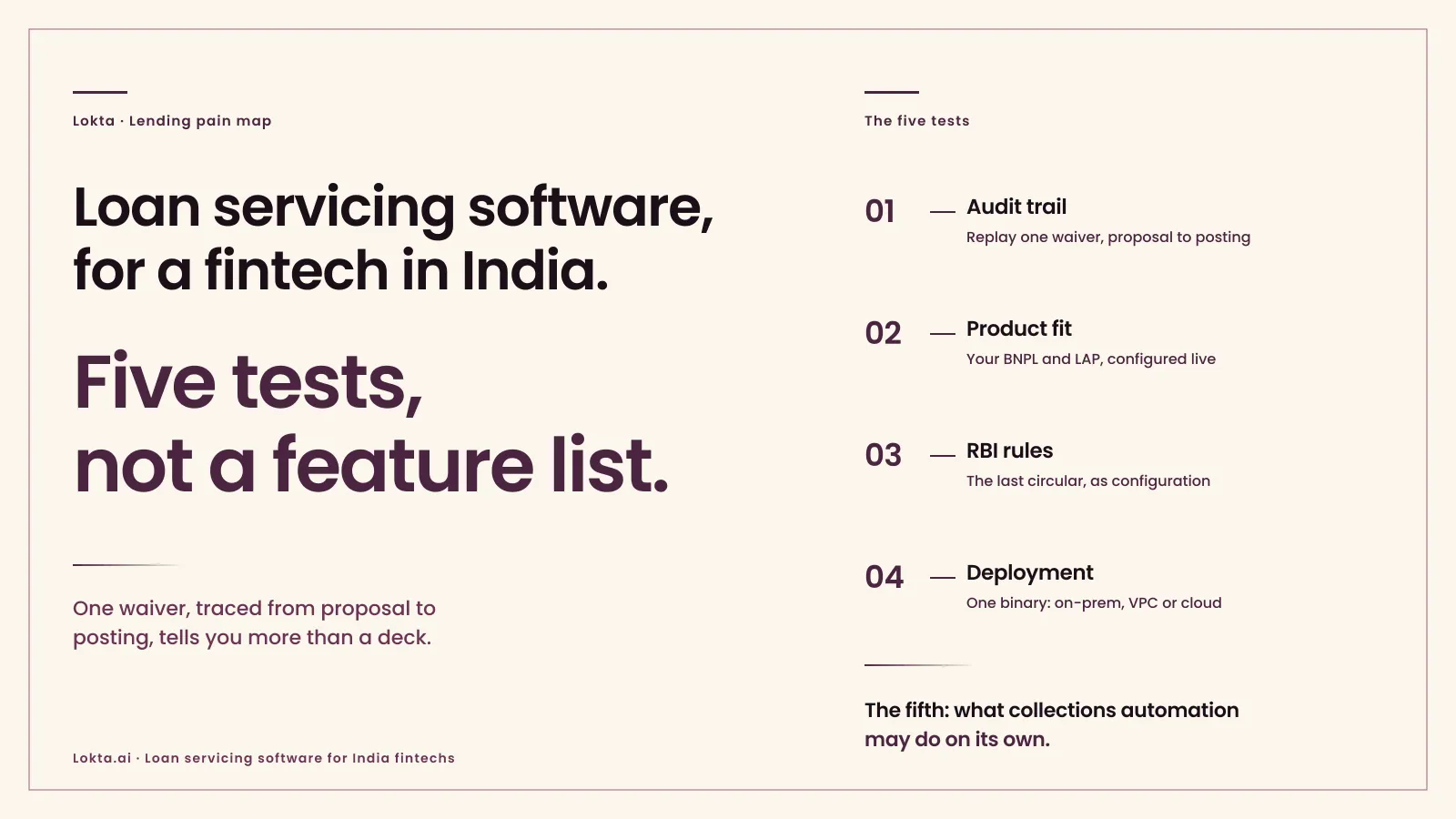
- Best loan servicing software for fintechs in India: five tests to run on every vendor
- SMA and NPA classification for NBFCs: the overdue bands, day-end dates and upgrade rules
- RBI recovery-agent rules for NBFCs: the evidence every collection contact should leave
Sources
- RBI: NBFC Responsible Business Conduct Directions, 2025. Penal, prepayment, reset and KFS rules (paragraphs 29 and 34); recovery conduct (paragraphs 91 and 100)
- RBI: NBFC Income Recognition, Asset Classification and Provisioning Directions, 2025. Paragraphs 18-25
- RBI: Prudential norms on IRACP, clarifications, 12 November 2021. Worked SMA and NPA dates
- RBI: NBFC Credit Information Reporting Directions, 2025 and the 2025 amendment, paragraph 4
- RBI: NBFC Transfer and Distribution of Credit Risk Directions, 2025. Part B, co-lending (paragraphs 102, 113, 117 and 124)
- RBI: NBFC Credit Facilities Directions, 2025. Chapter III, digital lending (paragraphs 10-11 on repayment flows)
- ICAI Journal: mandatory audit trail under the Companies (Accounts) Rules
- RBI: NBFC Cybersecurity, Technology: Risk, Resilience and Assurance Framework Directions, 2026. Audit trails by layer
- RBI: NBFC Managing Risks in Outsourcing Directions, 2025. Chapter IV
- RBI: draft Guidance on Regulatory Principles for Model Risk Management, June 2026
- RBI: draft Guidance on Regulatory Expectations for Data Governance, July 2026
Lokta editorial analysis by Chandramouli, co-founder and CEO.